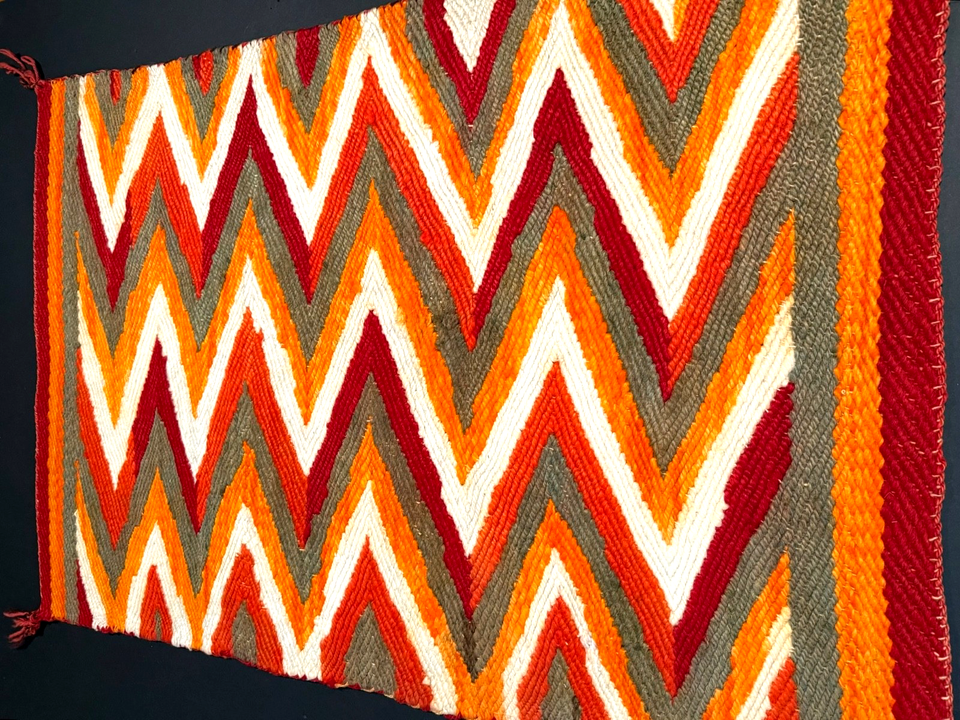
"zigzag Lines Symbolical Of Lightning" Navajo Blankets

There is a quiet, powerful magic in a Navajo blanket. Woven by hand with meticulous precision, these textiles are more than just warm coverings; they are woven prayers, maps o...

There is a quiet, powerful magic in a Navajo blanket. Woven by hand with meticulous precision, these textiles are more than just warm coverings; they are woven prayers, maps of the cosmos, and living records of a people’s deep connection to the land. Among their most captivating motifs is the zigzag line, a symbol that crackles with energy and meaning. People collect and cherish these blankets not only for their striking beauty but for the story they tell—a story of balance, power, and the life-giving force of nature. To own one is to wrap oneself in a piece of the desert sky, in the very essence of a thunderstorm.
The key purpose of the zigzag pattern is its representation of lightning (atsiniltłʼish in the Navajo language). In the Navajo worldview, lightning is a sacred, potent force. It is not a random act of destruction but a necessary cleanser and a messenger between the Earth and the Sky. The zigzag lines on a blanket, often stitched in white, turquoise, or black against a neutral background, capture this duality: the raw, untamable power of the storm, balanced with the life-giving rain that follows. For the weaver, incorporating this symbol is an act of prayer for harmony, a request for the cleansing energy of lightning without its destructive potential.
In everyday life, this symbolism offers profound benefits. Imagine a chilly evening in the Southwest, where the air is thin and the stars are sharp. You wrap a finely woven Navajo blanket around your shoulders. The zigzag lines tracing across the wool are not mere decoration; they are a reminder of resilience. They whisper that storms—both literal and metaphorical—are temporary and necessary. The blanket becomes a tool for grounding, a tactile connection to a wisdom that sees chaos as a precursor to renewal. For someone living in a fast-paced city, this same blanket can be a calming anchor. It is a daily visual cue to embrace life’s unpredictability while trusting the cycle of destruction and creation that brings balance back into your home.
Must Read
Consider a specific scenario: A family in Arizona hangs a vintage Navajo blanket on their wall. Each day, the children see the jagged, white lightning bolts weaving through bands of darker colors. This is not just interior design; it is a lesson in geometry and myth woven into the fabric. The parents use the blanket to explain how the Navajo people saw the world—where every pattern holds a story of survival. The zigzag lines teach the children that energy can be channeled, that power can be beautiful, and that even the most turbulent forces (like a tantrum or a difficult test) can be guided into a productive path. The blanket silently educates, comforting the household with the knowledge that harmony is always possible after the storm.
 Chief's Blankets Archives - Red Mesa Gallery
To appreciate these designs yourself, start by looking for controlled chaos. A genuine Navajo lightning blanket will have zigzag lines that are sharp, bold, and often interrupted by small solid blocks—these represent the sacred, life-giving raindrops or seeds that fall with the lightning. These “breaks” in the line are crucial; they show the weaver’s respect for the sacred, acknowledging that no human should perfectly replicate a deity’s creation. Next, feel the wool. Traditional blankets are made from Churro sheep wool, which has a distinct, slightly oily texture and a sturdy resilience. This tactile experience connects you directly to the landscape of the Four Corners region, where the sheep and the weavers have lived for centuries.
Finally, seek out the story behind the weaver. Many modern Navajo artisans will share the meaning behind their zigzag designs if you ask respectfully. In a gallery or at a Native American market, ask: “What does this pattern mean to you?” You may learn that the zigzag represents a journey across a sacred mountain, or a recording of a specific lightning strike that brought rain to a drought-stricken field. By understanding the narrative, the blanket transforms from a decorative object into a relationship—a bridge between your life and the enduring, electrifying wisdom of the Navajo people. Whether draped over a sofa or worn as a shawl, let those zigzag lines remind you that power, properly respected, becomes a source of life.