When Does Week 1 Start In 2026

Welcome to the wonderfully nerdy world of week numbering—a subject that, believe it or not, can save you from missed deadlines, botched quarterly reports, and even internation...
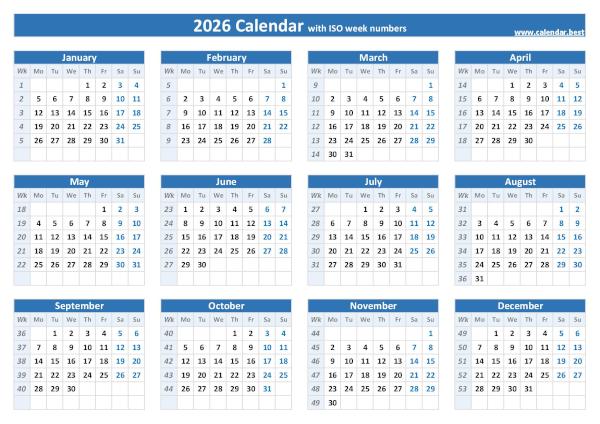
Welcome to the wonderfully nerdy world of week numbering—a subject that, believe it or not, can save you from missed deadlines, botched quarterly reports, and even international travel confusion. If you’ve ever scratched your head at a planner that says "Week 1" in January while your calendar insists it’s still December, you’re not alone. Understanding when Week 1 starts in 2026 isn’t just for accountants or project managers; it’s a fun little skill that unlocks clarity in scheduling, helps you sync with global teams, and makes you the hero of your own time management. The best part? Once you master the secret, you’ll never fear a “Week 52 vs. Week 1” showdown again. Let’s dive into the delightful chaos of dates!
The core purpose of a standardized week numbering system—like the widely used ISO 8601 standard—is to give everyone a universal reference point. Instead of saying “the first week of January,” which is vague, you say “Week 1 of 2026,” and boom: everyone from Sydney to Seattle knows exactly which seven days you mean. The biggest advantage? No more ambiguity. For example, if your company’s fiscal year starts on a Monday, but the calendar year kicks off on a Thursday, ISO weeks let you align financial reports without fuss. Plus, if you’re planning a global team meeting or a series of deadlines, using ISO week numbers cuts through the noise of “first week,” “first full week,” or “first Monday week.” It’s like a secret handshake for the meticulously organized—and it’s surprisingly fun to wield.
So, when does Week 1 actually start in 2026? Brace yourself for the twist: Week 1 of 2026 begins on Monday, December 29, 2025. Yes, you read that right—before the new year even arrives. Under ISO 8601, Week 1 is always the week that contains the first Thursday of the year. In 2026, January 1 falls on a Thursday, which means that the Monday through Sunday surrounding that Thursday (Monday, Dec 29, 2025 to Sunday, Jan 4, 2026) becomes the official Week 1. This quirk means that part of the “old” year actually belongs to the “new” year’s week count. Imagine your 2026 plans starting while you’re still nibbling holiday leftovers! It’s a little counterintuitive, but once you get it, you’ll feel like a date detective cracking a case.
Must Read
Let’s play with some creative examples to make this stick. Picture this: You’re a freelancer who wants to launch a 12-week email course starting with Week 1. If you schedule your first email for January 3, 2026 (a Saturday), you’re actually still in Week 1—hooray, perfect alignment. But if you wait until January 5 (Monday), you’ve already slipped into Week 2. Another scenario: You’re coordinating a virtual summit and want to announce the date as “Week 3, 2026.” Using a calendar app that respects ISO weeks, that translates to January 12–18. Your international colleagues will nod in unison because they see the same numbers. For maximal fun, try planning a “Week 1 kickoff party” on January 1, 2026 (Thursday) as a hybrid work-social event—it’s a celebratory way to mark the first Thursday and thus the heart of Week 1. These small hacks turn a dry standard into a playful scheduling tool.
Now, for practical advice: First, always check your calendar app’s settings. Most modern tools (Google Calendar, Outlook, Apple Calendar) let you toggle “ISO week numbers” in the view options. Turn that on—it’s like adding a secret layer to your map. Second, if you’re planning long-term projects, note that the last few days of 2025 belong to 2026’s Week 1. So if you’re mapping out Q1 of 2026, start your timeline on Monday, Dec 29, 2025. Third, when sharing deadlines with others, always pair the week number with a date range to avoid confusion. For example, say “the deadline is in Week 1 of 2026 (Dec 29–Jan 4)” rather than just “Week 1.” Finally, use a dedicated ISO week calculator website or a simple formula: the week containing the first Thursday of the year is Week 1. For 2026, that’s the week with Jan 1 (Thursday), so mark it on your physical or digital planner now.
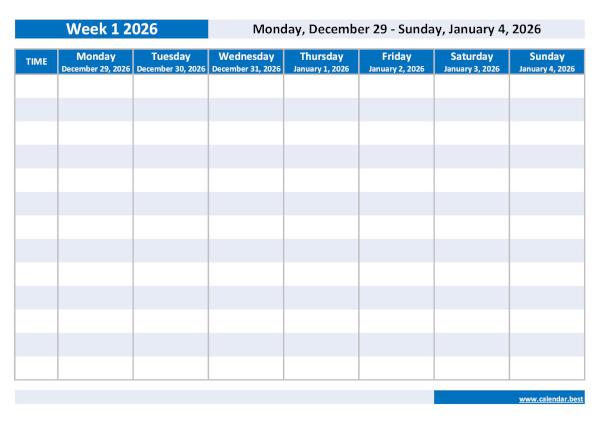 Week 1 2026: dates, calendar and weekly schedule to print
To make this even easier, here’s a quick cheat sheet for 2026: Week 1 runs Monday, Dec 29, 2025, through Sunday, Jan 4, 2026. Week 2 starts Monday, Jan 5, and so on. This means December 31, 2025 (Wednesday) is still part of Week 1 of 2026—a fantastic trivia fact to drop at a New Year’s Eve party. If you’re a teacher planning a semester, you can use this to align your lesson plans with “academic week numbers” that start on Mondays. For travelers, knowing that Jan 1 is a Thursday means you might want to book flights for the preceding Monday to maximize the “first week” vibe. The key is to embrace the quirkiness rather than fight it—once you do, week numbers become a reliable compass rather than a puzzle.
In conclusion, understanding when Week 1 starts in 2026 is like learning a secret language that makes you more efficient, precise, and impressively nerdy. You now know that the year begins with a mini “tail” from December 2025, and that the first Thursday is your guiding star. The advantages are clear: no more vague “early January,” seamless collaboration across time zones, and the quiet satisfaction of seeing your calendar perfectly aligned. So go ahead, set your calendar app to show ISO weeks, and treat yourself to a chuckle when someone says “the first week of January.” You’ll know exactly which days that means—and you might even start a fun conversation about why it works this way. Cheers to 2026, and may all your weeks be numbered—correctly!

