What's The Difference Between A Wolf And A Dog

So, you’re at a café, right? You see a “dog” outside, all shaggy and intense, and you think, “Is that a wolf? Or just a very serious husky with a bad attitude?” Trust me, you...

So, you’re at a café, right? You see a “dog” outside, all shaggy and intense, and you think, “Is that a wolf? Or just a very serious husky with a bad attitude?” Trust me, you are not alone.
The short answer is: a wolf is a wild animal that would eat you for breakfast, and a dog is a golden retriever who would eat your breakfast if you dropped it. But the long answer is way more fun—and involves a shocking amount of butt-sniffing science.
The Family Reunion You Didn’t Ask For
First, the genetic table. Wolves and dogs share 99.9% of their DNA. That’s like saying you and your cousin share 99.9% of your DNA—except your cousin has fangs and howls at the moon and your cousin eats kibble from a bag labeled “Senior Blend.”
Must Read
They are both technically Canis lupus for wolves, and Canis lupus familiaris for dogs. Translation? A dog is basically a wolf that got a glow-up after 15,000 years of begging for table scraps. It’s like the domesticated wolf decided to trade the hunting pack for a couch and a belly rub.
The Head Shape: Brain vs. Brawn
Look at a wolf’s head. It’s massive, like a linebacker on steroids. The skull is longer, the snout is wider, and the jaw muscles can crush a moose femur. Your dog’s head? It’s often a squished, adorable mess, like a pug that ran into a wall.
Wolves have narrower chests and longer legs built for marathon running—20 miles a day, easy. Your dog? He’s built for sprinting to the fridge. A wolf’s ears are always rounded and perky, while a dog’s ears can flop like sad pancakes. That floppy ear gene? It’s a domestication mutation. Wolves would starve if their ears blocked their hearing.
The Eyes Have It (And They’re Creepy)
Look into a wolf’s eyes. I dare you. They’re yellow or amber, with a dark ring around the iris—like a predator’s highlighter. Dogs? Their eyes are brown, blue, or even mismatched, and they have visible whites (the sclera). This lets them make “puppy dog eyes” to manipulate you.
Wolves have no whites showing. Their eyes are all pupil and menace. It’s why staring into a wolf’s eyes feels like a threat, but staring into your dog’s eyes is just… “Did you drop a Cheerio?”
How They Act at a Party
Imagine you host a dinner party. A dog will greet you at the door, wag its tail, and try to hump a guest’s leg. A wolf will slink in sideways, avoid eye contact, and probably knock over your table to assert dominance.
Wolves never wag their tails in joy. They hold them straight out or low. A “happy” wolf is like a “happy” serial killer—it looks wrong. Dogs wag their tails in circles, like a helicopter of pure delight. Science says wolves wag tails only to signal submission, not friendship. So your dog’s tail wag is a lie—but it’s a beautiful, domesticated lie.
The Barking Debate (Who’s the Loudmouth?)
Wolves rarely bark. They howl, they growl, they whimper—but barking is for amateurs. Dogs? They bark at everything. The mailman. A leaf. Their own farts. Barking is a juvenile trait that dogs kept into adulthood, like a man-child who still watches cartoons.
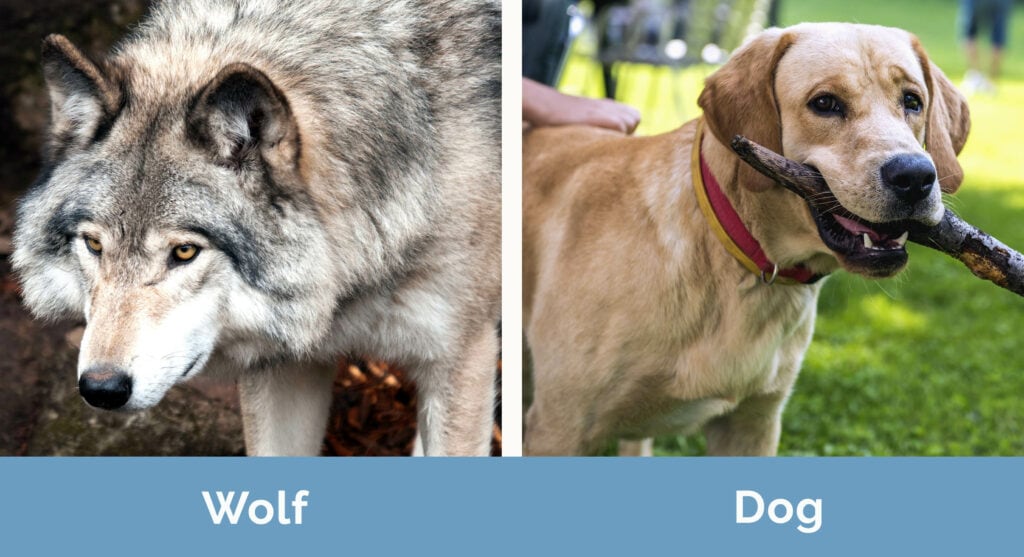 Difference Between Dog And Wolf – JEWYLV
Wolves reserve barking for alarms or threats. A wolf that barks a lot would get kicked out of the pack. A dog that barks a lot gets a treat and a “Good boy!” We literally bred them to be noisy idiots.
Survival Skills: You vs. Them
You cannot survive on a wolf’s diet. A wolf eats 20 pounds of raw meat a day, including bones, fur, and stomach contents. That’s like eating a whole deer, twice. Your dog? A dog will eat soy-based kibble and then beg for a slice of your avocado toast.
Wolves are afraid of humans. Truly. After centuries of being shot and poisoned, they see you as a death omen. Dogs see you as a vending machine. A wolf’s first instinct is to run—unless it’s starving. A dog’s first instinct is to lick your face and wait for a treat. One will cuddle you; the other will use your bones for toothpicks.
The Surprising Fact That Will Blow Your Mind
Here’s the kicker: Wolves can’t fetch. Not naturally. If you throw a stick, a wolf will look at you like, “You threw a stick. So what?” Dogs, however, have a genetic mutation in a gene called WBSCR17 that makes them obsessed with retrieving objects. It’s literally in their DNA to bring you the ball. Wolves don’t care about your problems.
Also, wolves smell 100 times better than dogs, but they use that power to track prey across tundra. Dogs use that power to find the one cracker you dropped under the sofa three weeks ago. Same nose, different priorities.
Can You Own a Wolf? (Spoiler: No, Stop It)
Please do not get a wolf as a pet. It’s like adopting a tiger because you like orange cats. Wolves are illegal in most states and will destroy your house, your yard, and your sense of security. They’re terrified of strangers and will hide under your bed for hours.
Wolf-dog hybrids are even worse. They have the cunning of a wolf and the impulse control of a labrador. That combo means they’ll eat your couch and then look guilty about it—while plotting your demise. Just get a husky. They look like wolves, act like drama queens, and won’t eat your cat.
The Final Verdict
So, what’s the difference? A wolf is a wild masterpiece of evolution—a predator that respects no boundary. A dog is a domesticated goofball who thinks you’re a god because you open a can of food. One howls to call the pack; the other howls because the fire truck went by.
Next time you see a “wolf-like” dog, just ask: Does it want to hunt for survival, or does it want to watch Netflix with you? That’s the difference. And please, don’t try to pet the wolf. Stick to the golden retriever. Your fingers will thank you.
