What Percent Alcohol Is Vodka

So, you’re staring at a bottle of vodka, squinting at the label, and wondering: “What percent alcohol is *this* stuff, really?” It’s a fair question, especially if you’ve ever...
So, you’re staring at a bottle of vodka, squinting at the label, and wondering: “What percent alcohol is this stuff, really?” It’s a fair question, especially if you’ve ever woken up after a party convinced you could speak fluent Russian. Spoiler alert: you couldn’t, and the vodka is why. Let’s dive into the clear, burning truth, shall we?
The Not-So-Mystical Number: 40%
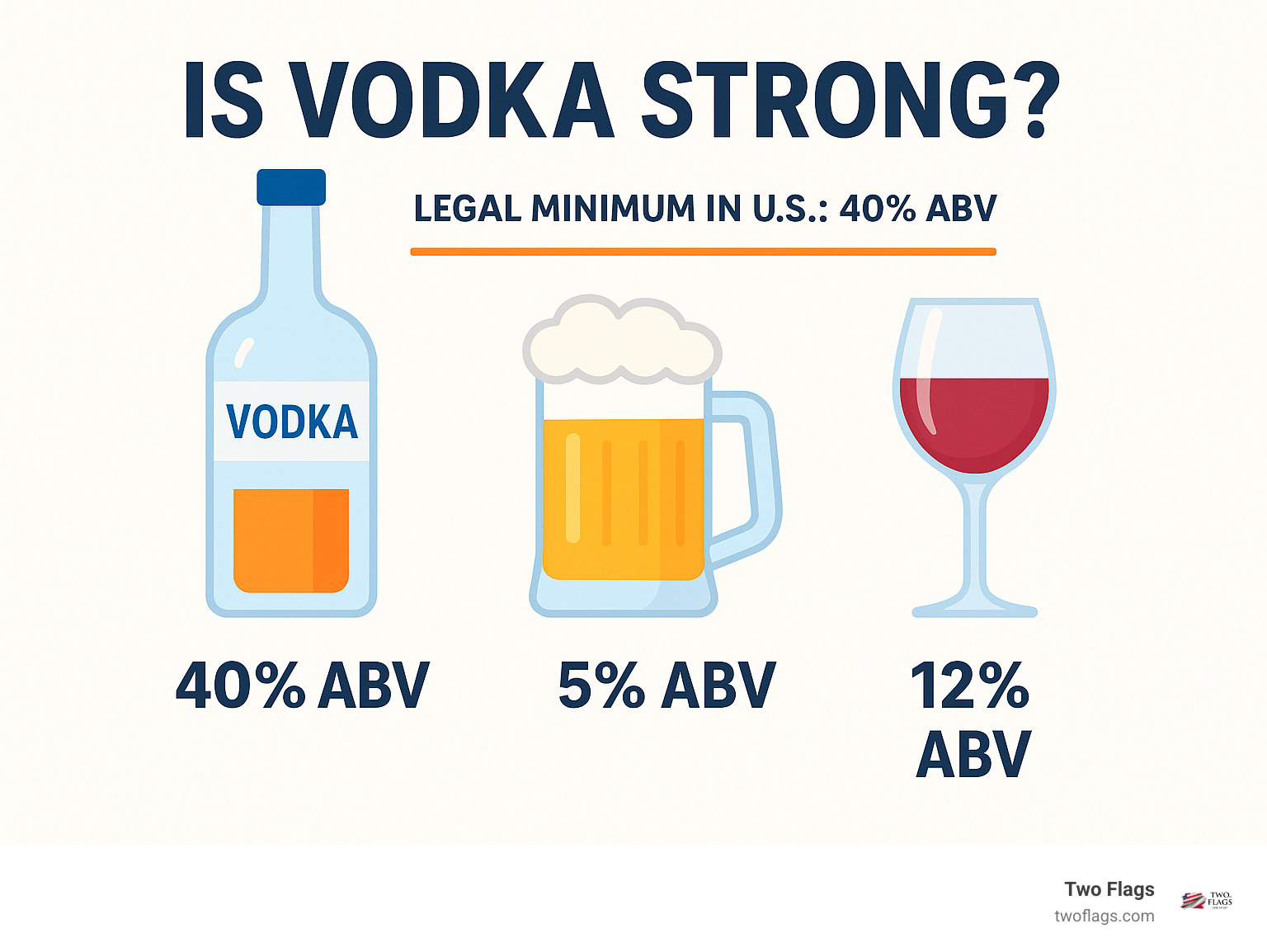
Here’s the headline: most vodkas clock in at exactly 40% alcohol by volume (ABV). That’s 80 proof for the American math-o-phobes out there. Why 40%? It’s like the universe decided that’s the sweet spot between “fun buzz” and “accidentally painting your face with ketchup.” Blame history—or a very eccentric Russian chemist named Dmitri Mendeleev who, legend has it, decided that 40% was the perfect concentration for mixing with water.
Now, 40% isn’t a law written in vodka-soaked stone. You’ll find outliers that flex their alcoholic muscles. Some craft vodkas hit 50% (100 proof), and if you’re feeling particularly masochistic, there are bottles pushing 60% or even 80% ABV. That’s basically lighter fluid with a fancy name. Drink that, and you’ll forget your own name, your social security number, and the plot of The Godfather—all at once.
Must Read
The “Proof” Jargon: Why Is It Called That?
Speaking of proof, let’s clear up that nonsense. Proof is just double the ABV, so 40% becomes 80 proof. Why “proof”? Back in the 1700s, British sailors would test their rum by soaking gunpowder in it. If the gunpowder still lit on fire, the liquor was “proved” strong enough to drink. Imagine that as a party trick: “Hey, Bob, hold my beer—I’m about to prove this isn’t water!”
Here’s where it gets silly: most countries have legally mandated minimums for vodka. In the U.S., it’s 40% ABV or bust. The E.U. says it must be at least 37.5%. Potato, schmotato—the point is, you’re not drinking juice. You’re drinking a chemical that could theoretically power a lawnmower. But I digress.
The Gentlemen’s Agreement: Why 40% Isn’t Chaotic
Why don’t distillers just crank it up to 95% and call it a day? Because your taste buds would sue you for assault. High-proof vodka tastes like a fire alarm made of nails. The 40% mark is a delicate balance: it’s strong enough to give you that warming hug, but weak enough that you can still taste the, uh, “botanical notes.” (Spoiler: it tastes like nothing, which is exactly why we love it.)
 Understanding Vodka's Alcohol Content: What Percentage Defines The
Fun fact: cheap vodkas often hover near 40% but cut corners with water—which is fine, because you’re probably mixing it with Red Bull anyway. Expensive vodkas? They might hit 50% because they’re “craft” and expect you to sip it like a snob. Just remember: if you’re paying $80 for a bottle that’s 45% alcohol, you’re paying for the story and the fancy bottle, not the math.
The High-Proof Hall of Shame
Let’s talk about the lunatics. Spirytus Rektyfikowany from Poland is 96% alcohol. That’s not vodka; that’s a driven chemical weapon. You’re supposed to dilute it, but some thrill-seekers drink it straight. The result? Instant regret and a permanent smell of rubbing alcohol on your breath. There’s also Everclear (95% ABV), which Americans use to clean their grills and then, for some reason, mix with punch at frat parties. Don’t be that person.
But for sanity’s sake, your standard vodka is a boring, reliable 40%. That’s why it’s the hero of every martini, the backbone of every Bloody Mary, and the reason your aunt thinks she’s a secret agent after two sips. It’s predictable, which is a gift in a world of chaos.
The Cold Truth: Freezing Changes Nothing
Here’s a weird science tidbit: vodka’s alcohol percentage means it won’t freeze in your home freezer. Water freezes at 32°F; pure ethanol at -173°F. Because 40% vodka is mostly water, it gets slushy around -10°F. So if you stick it in the freezer and it looks like syrup? That’s fine. It’s just the water crystalizing and throwing a little tantrum. The alcohol stays liquid, laughing at the water like, “Ha, amateur.”
 Is Alcohol Proof The Same As ABV? | Britannica
I’ve known people who think freezing vodka makes it “stronger.” No, you sillies. It just makes it less painful to drink, like putting a cast on a broken leg. The percent doesn’t change because you’ve got a brain freeze.
The Final Pour
So, to wrap it up: vodka is almost always 40% alcohol by volume. That’s the law, the tradition, and the reason you can still walk to the bathroom after two glasses. If someone hands you a bottle marked 95%, politely decline—or offer to use it as hand sanitizer. And if you ever see a label that says “30%,” it’s probably just vodka’s shy cousin that failed alcohol school.
Next time you’re at a bar and the bartender asks, “What proof?” just smile and say, “80, baby—keep it classic.” They’ll either high-five you or roll their eyes, but either way, you’ll have the upper hand. And if they try to lecture you about “grain-to-glass,” just take a sip, nod, and go back to scrolling the internet for cat videos. Because in the end, vodka is 40% alcohol, 60% social lubricant, and 100% a terrible idea before a meeting.
Cheers!
