What Is The Internal Cooking Temperature For Chicken

So, you’re staring at a raw chicken breast, and a tiny voice in your head whispers, “Is it… safe?” You’re not alone. We’ve all been there, poking at the meat with a fork, wond...

So, you’re staring at a raw chicken breast, and a tiny voice in your head whispers, “Is it… safe?” You’re not alone. We’ve all been there, poking at the meat with a fork, wondering if that faint pink hue means danger or just dinner. The big question is simple: what is the internal cooking temperature for chicken?
The short, no-nonsense answer is 165°F (74°C). That’s the magic number the USDA wants you to hit. It’s the temperature where Salmonella and other nasty bacteria throw in the towel. Think of it like the final boss in a video game—once you hit 165°F, you’ve won the level.
But why 165°F? Isn’t that a bit specific? It is, and that’s what makes it cool. At that exact temperature, the heat instantly kills off harmful bacteria. It’s not a slow cook; it’s a decisive victory. You don’t need to hold it there for ten minutes—just one second at 165°F is enough.
Must Read
Here’s where it gets interesting: white meat and dark meat don’t always behave the same way. A chicken breast is lean and dries out fast. Dark meat, like thighs and drumsticks, is fattier and more forgiving. But both must hit 165°F to be safe. No shortcuts, no guessing games.
Wait, you might ask, “Can’t I just cook it until the juices run clear?” That old saying is about as reliable as a weather forecast from a groundhog. Juices can “run clear” at 155°F, which is not safe. Trust the thermometer, not your eyes. Your chicken will thank you.
Let’s talk about the thermometer itself. It’s your best friend in the kitchen—a tiny, metal detective that tells you the truth. Stick it into the thickest part of the meat, avoiding the bone. If you hit bone, you’ll get a false reading, and that’s like map-reading with a blindfold on.
Now, here’s a fun comparison: Imagine your chicken is a spaceship entering Earth’s atmosphere. At 165°F, the heat shield is fully deployed. Anything less, and the astronauts—your dinner guests—might not make it. Anything more, and you’re burning up on re-entry. That’s your sweet spot.
What about cooking methods? Grilling, baking, frying—it doesn’t matter. The law of 165°F applies everywhere. Even if you’re slow-cooking a whole bird in a crockpot, you still need that temperature. It’s like gravity: it doesn’t care how you’re moving; it just works.
But here’s a secret chefs know: you can actually cook chicken to 155°F—if you hold it there for about a minute. It’s called pasteurization. The heat slowly kills the bacteria over time. Most home cooks don’t bother with this math, and honestly, why would you? An extra five degrees is peace of mind.
Let’s be real: dry chicken is a tragedy. It’s the culinary equivalent of a flat joke. But hitting 165°F doesn’t have to turn your dinner into sawdust. The trick is to pull the chicken off the heat at 160°F, then let it rest. During the rest, the temperature will climb those final five degrees. It’s like a post-game win.
You know what’s wild? Poultry is the only meat with this 165°F rule. Beef can be rare. Pork can be medium. Chicken? It’s the strict teacher in the lunchroom. That’s because chickens carry bacteria more easily than cows or pigs. It’s not being unfair; it’s just biology.
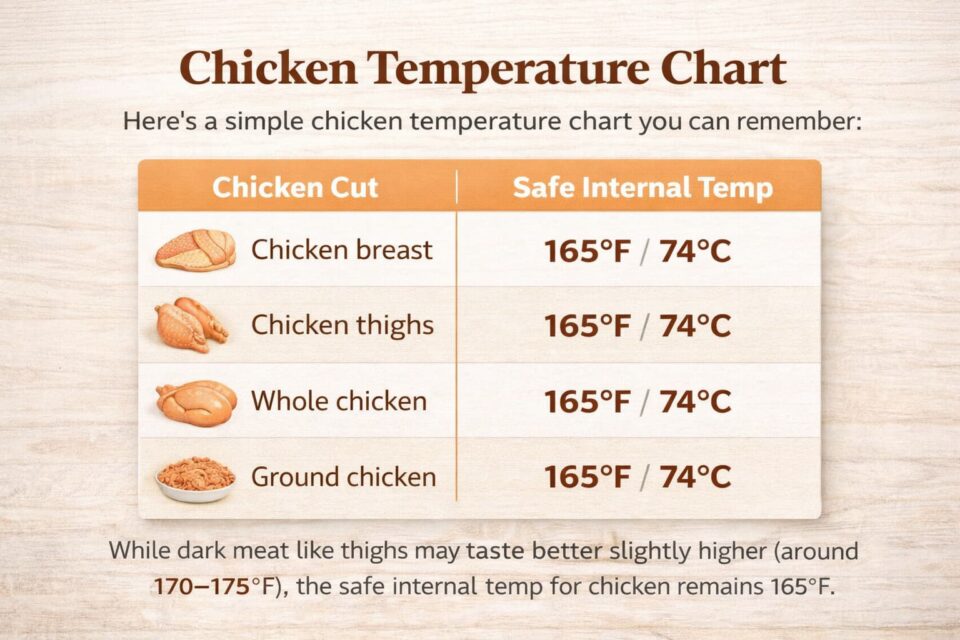 Chicken Internal Temp: The Secret to Safe, Perfect Chicken - Foodiosity
Think about your favorite fried chicken joint. That golden, crispy crust? It’s delicious, but the inside needs to be 165°F. The oil temperature and the size of the piece all matter. A big thigh might need an extra minute. A tiny wing might be done sooner. That’s why pros never guess.
Do you really need a fancy probe thermometer? Honestly, a simple digital one costs less than a latte. It’s a one-time investment that saves you from a night of regrettable takeout. Plus, it makes you look like a science wizard at the dinner table. Who doesn’t want that?
Here’s a mental trick: 165°F is the same heat as a hot summer day in Death Valley. Except your chicken is inside an oven, not baking in the desert. It’s a weird comparison, but it sticks. Next time you open the oven, imagine your chicken sunbathing—just turn it off before it gets sunburned.
What if you’re cooking a whole chicken? The thighs and legs take longer than the breast. You need to check multiple spots. If the thigh is at 170°F but the breast is at 155°F, you’ve got a problem. Carve it up, or cook it longer. The whole bird is a team sport.
And leftovers? Oh, those are a different game. Reheat them to 165°F again. No, you can’t just microwave them until they feel warm. That’s a rookie move. Zap them until the thermometer confirms it. Cold chicken salad is fine, but reheated chicken? Play it safe.
One more thing: color is not a reliable indicator. Pink meat isn’t automatically dangerous, and white meat isn’t automatically safe. A smoked chicken can be pink all the way through and still be 180°F. That’s chemistry, not danger. Trust the temperature, not the shade.
So next time you’re standing over a sizzling pan, remember: 165°F is your co-pilot. It’s the difference between a great story about dinner and a story about a trip to the ER. And honestly, you have better things to do than play bacterial roulette. Right?
Go ahead, cook that chicken with confidence. Poke it with your little metal friend, watch the numbers climb, and when it hits 165°F, give yourself a high-five. You’ve mastered the one rule that keeps chicken from being a cliffhanger. That’s pretty cool.
