What Does Vertex Mean In Math

Let’s be honest, math can sometimes feel like a foreign language, but one of its most charming words—vertex—is surprisingly easy to get along with. Think of it as the cool, ve...
Let’s be honest, math can sometimes feel like a foreign language, but one of its most charming words—vertex—is surprisingly easy to get along with. Think of it as the cool, versatile cousin in the geometry family. Whether you’re sketching a star, planning a garden path, or just trying to understand why that parabola in your algebra class looks the way it does, the vertex is your trusty friend. It’s a concept that pops up everywhere, from the tip of a triangle to the peak of a roller coaster hill, making it both practical and genuinely fun to spot. The real beauty? Once you know what to look for, you’ll see vertices in the world around you, turning everyday shapes into a playful little puzzle.
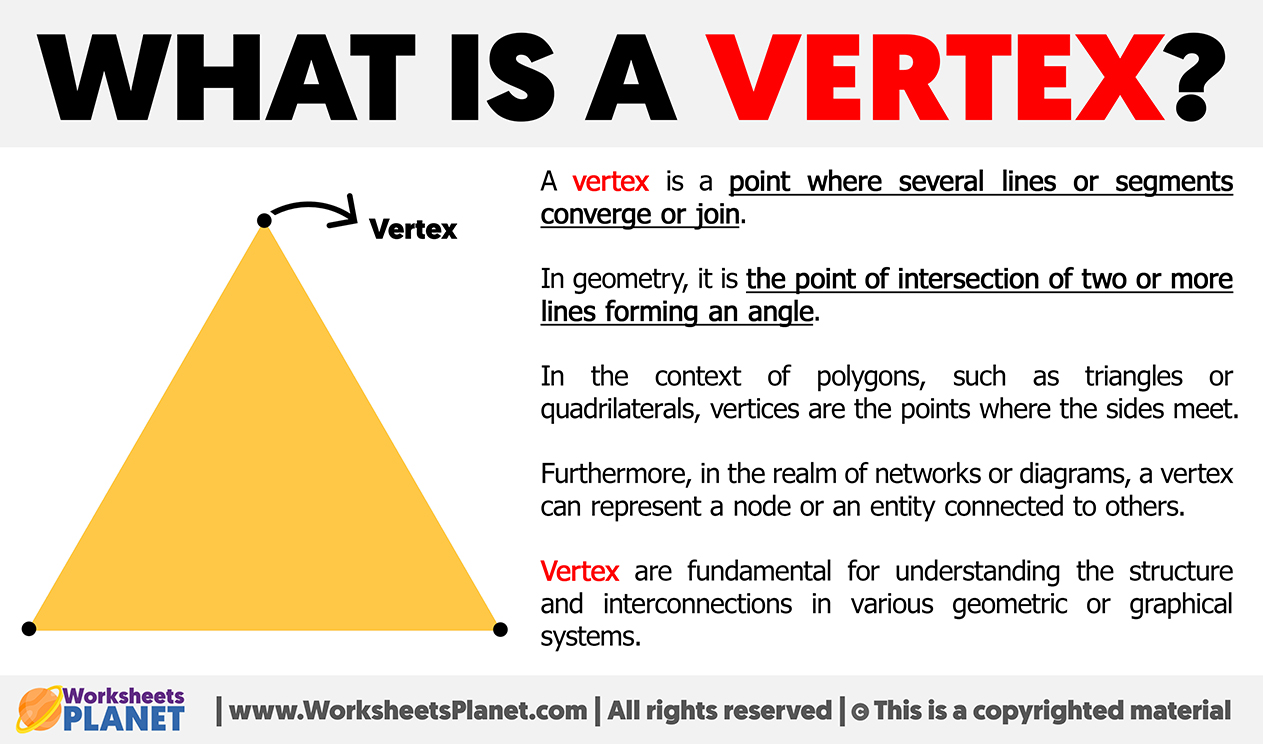
At its core, a vertex is simply a corner or a meeting point. More formally, it’s the point where two or more lines, rays, or edges come together. In a square, you have four vertices—one at each corner. In a triangle, you’ve got three. The term isn’t just for flat shapes, though; 3D objects like cubes have vertices too, where three edges meet. No matter the shape, the vertex is the star of the show—it’s the place where the magic happens. For architects and designers, these points are crucial for stability and aesthetics. For kids learning shapes, identifying a vertex is often the first step toward mastering geometry. It’s a simple idea, but it’s the building block for much bigger concepts.
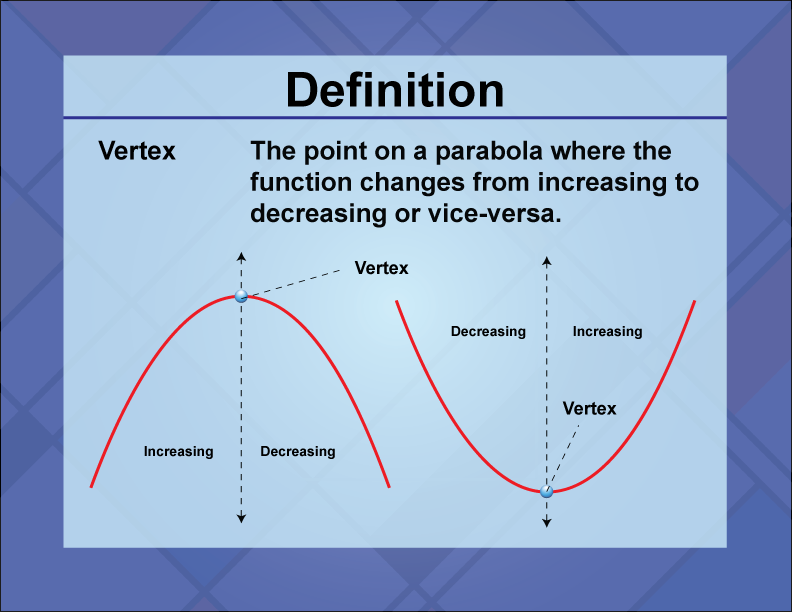
One of the most common variations you’ll meet is the vertex of a parabola. If you’ve ever thrown a ball or watched water spray from a fountain, you’ve seen a parabola in action. The vertex is the highest or lowest point on that U-shaped curve—the peak of the arc. In a quadratic equation like y = x², the vertex is right at the origin (0,0). But in real life, that vertex might be the maximum height of your basketball shot or the minimum point of a suspension bridge cable. Mathematicians and engineers love this vertex because it tells you the optimum—the best or worst value in a system. For students, learning to find it quickly is like unlocking a secret level in a video game.
Must Read
Another everyday sighting is in angles. When you hear “vertex of an angle,” it’s simply the point where the two arms of the angle meet. Picture a pair of open scissors—the screw holding them together is the vertex. Or think of a pizza slice: the tip of the slice is the vertex of the angle. This is incredibly useful for carpenters cutting wood, artists sketching perspective, or even navigators plotting a course. By identifying the vertex, you can measure and compare angles, which is the heart of everything from trigonometry to simple map reading. It’s a quiet, powerful idea that helps us describe the world precisely.
Here’s a simple, actionable tip to get comfortable with vertices: start counting. Look around your room right now. How many vertices does your bookshelf have? Your phone screen? A cereal box? Count the corners—those are your vertices. Next, try drawing a five-pointed star. A star has ten vertices (the five outer points and the five inner points), but not all are obvious at first glance. This little exercise trains your eye to see shapes as networks of points and lines. It’s a great trick for kids learning geometry, but it also helps adults visualize complex problems in coding, physics, or design.
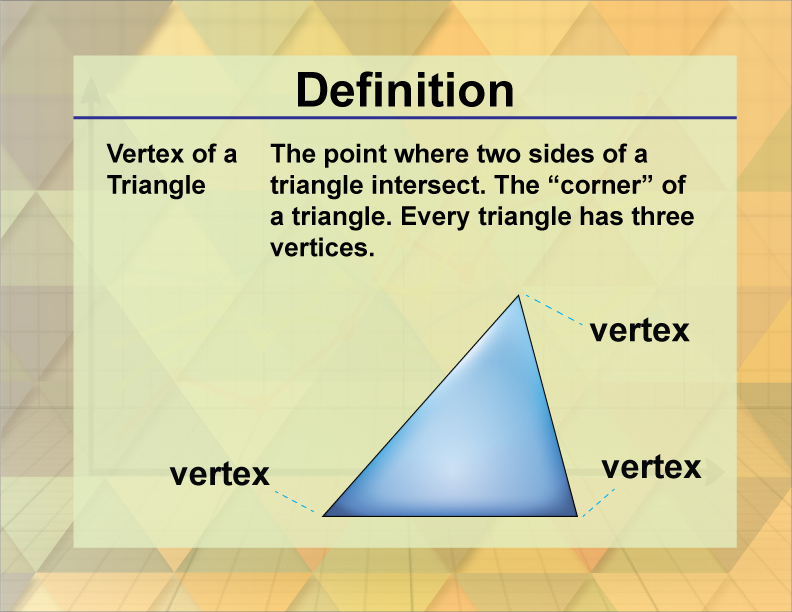 Definition--Triangle Concepts--Vertex of a Triangle | Media4Math
To make the most of this concept, remember that a vertex is always a point of connection. When working with graphs or algebra, always ask: “What is the highest or lowest point here?” That’s your vertex in action. If you’re sketching a floor plan, label every corner as a vertex and you’ll avoid measurement mistakes. And if you’re teaching someone, use real objects—like a folded napkin or a road sign—to show how vertices aren’t abstract; they’re as real as the corner of your desk. The more you look, the more you’ll appreciate how this tiny point holds whole shapes together.
Ultimately, the vertex is a perfect example of math being both approachable and deeply useful. It’s a single word that bridges the gap between a child’s coloring book and a rocket scientist’s blueprints. Whether you’re optimizing a budget with a graph, designing a logo, or just keeping the kids entertained on a rainy day, the vertex is your reliable, pointy little friend. So next time you see a corner, smile and give it a nod—you’ve just met the vertex, and it’s got your back.