What Does Out And Back Mean

So, you’re scrolling through your hiking app, or maybe you’ve just overheard your annoyingly fit friend talking about their weekend plans, and they drop the phrase: “Oh, it wa...

So, you’re scrolling through your hiking app, or maybe you’ve just overheard your annoyingly fit friend talking about their weekend plans, and they drop the phrase: “Oh, it was just a quick out and back.”
You nod, smile, and pretend you know exactly what that means. But inside? You’re picturing a dramatic escape from a burning building, or maybe a very confused courier who forgot their delivery address. Don’t worry—you’re not alone. Let’s unpack this little gem of outdoor lingo, and I promise, it’s way less stressful than it sounds.
Simply put, an out and back is exactly what it says on the tin: you go out along a trail, path, or route, and then you turn around and come back the exact same way you came. No loops, no fancy detours, no secret shortcuts. It’s the trail equivalent of reading a book and then reading it again backward to check you didn’t miss a plot point. Thrilling? Not always. Efficient? Absolutely.
Must Read
Think of it like this: if you were walking to a coffee shop, got your latte, and then walked home by retracing your steps—boom, you just did an out-and-back. Only now, you’re probably doing it with a view of a mountain and way more mosquito bites. It’s the most honest kind of adventure. No pretending you’re Christopher Columbus discovering a new world; you’re just a person who knows that the way back is the same as the way forward, but with sore feet.
Why would anyone do this? Well, practicality, my friend. Out-and-backs are the ultimate low-stakes adventure. Need a short hike after work? Bam. Out and back. Don’t want to deal with complicated navigation while herding your kids and a golden retriever? Perfect. It’s the trail equivalent of that reliable pair of sweatpants you never want to wash—unexciting, but deeply comforting. Plus, you get to see the scenery twice. The first time, you’re fresh and chirpy. The second time, you’re a sweaty, wobbly mess, and you notice that gorgeous rock formation you completely missed on the way out because you were too busy tripping over a root. It’s like a second chance at nature.
Now, for the haters who say out-and-backs are boring—first of all, relax. Not every hike needs to be a dramatic loop with a waterfall finale. Sometimes, the best part is knowing exactly how much longer you have to suffer. That’s the secret joy: you can calculate your mileage with military precision. “Ah, three miles out. That means three miles back. I have exactly 2.5 songs, a podcast about the history of bread, and a mild existential crisis before I’m done.” It’s predictable, and sometimes predictable is beautiful.
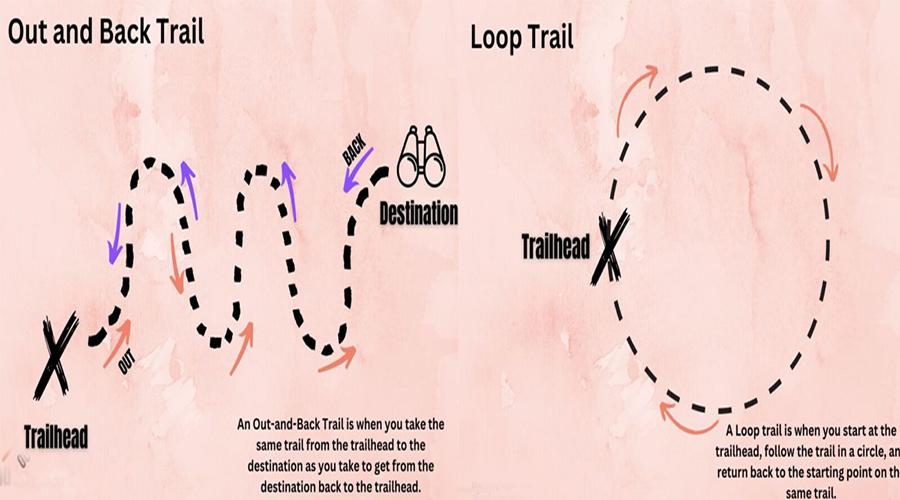 What Does Out and Back Trail Mean? The Optimal Guide 2024
Is it always the best choice? No. If you’re the type of person who hates backtracking—who feels like retracing a path is somehow cheating—then loops are your jam. But for the rest of us, the out-and-back is a gift. It’s a chance to see the world from a slightly different angle on the return trip. The shadows will be longer. The light will be different. That tree you ignored on the way out? Now it looks like it’s waving goodbye. Deep, right?
So the next time someone asks, “What does out and back mean?” you can say, with the confidence of a hiking guru, “It means I’m going to walk until I feel like stopping, then I’m going to turn around and do it all over again. It’s a round trip for your soul.”
And here’s the uplifting part—the part where you smile, I promise: life itself is a kind of out-and-back. We go out into the world, chasing sunsets, climbing hills, getting lost in good ways and bad. And eventually, we have to find our way back home, to ourselves, to the people who love us. The route might be the same, but you are never the same person coming back as you were going out. Every out-and-back leaves you a little stronger, a little wiser, and maybe just a little bit dustier. And that, my friend, is a beautiful thing. Now go find your trail—and don’t forget to turn around.
