What Does Dog Vision Look Like

Have you ever looked at your dog, head tilted, staring at something you can’t see, and wondered what’s going on in their head? Do they see the world like we do, all crisp and...
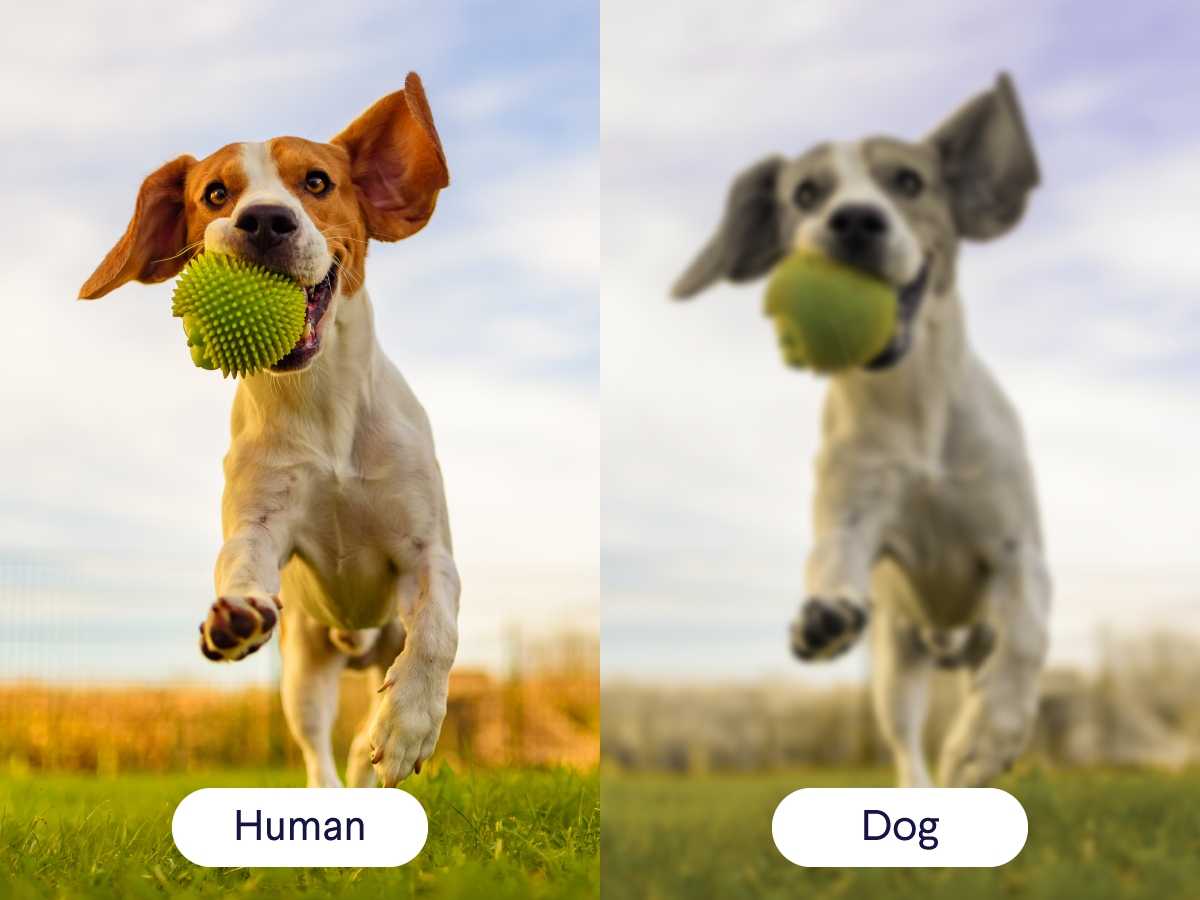
Have you ever looked at your dog, head tilted, staring at something you can’t see, and wondered what’s going on in their head? Do they see the world like we do, all crisp and colorful? The answer is both surprisingly different and unexpectedly cool.
Let’s get one big myth out of the way: dogs do not see in black and white. That old idea is totally wrong. Your pup sees a version of the world that’s more like a faded, muted rainbow.
Imagine looking at a gorgeous sunset, but the reds and oranges look more like browns and yellows. That’s basically dog vision. Their eyes have fewer color-detecting cells than ours, so they’re what scientists call dichromatic.
Must Read
Think of it like an old-school color TV with only two knobs: blue and yellow. Your dog sees blues as blue, yellows as yellow, but reds and greens? They just look like shades of gray or brown. That’s why that red ball on green grass might as well be invisible to them!
So if color isn’t their superpower, what is? It’s motion and night vision. Dogs have way more rod cells in their retinas than humans do, which makes them incredible at seeing movement in low light.
Ever notice how a squirrel can freeze and your dog walks right past it? That’s because their brain is wired to spot moving things first. To a dog, a still object is just background noise, but a quick flicker across the yard is a flashing neon sign.
Their night vision is about three times better than ours. While you’re squinting in a dim room, your dog is probably watching that dust bunny roll by like it’s midday. It’s like they have natural night vision goggles built in.
Another fascinating quirk is their field of view. Because their eyes are on the sides of their head, most dogs have a 240-degree panoramic view. We humans only get about 180 degrees. That means they can spot you sneaking up from the side without even turning their head.
But there’s a trade-off. Their depth perception isn’t as sharp as ours, especially up close. If you toss a treat right near their nose, they might miss it on the first try. They rely on that wide view to track prey at a distance, not to thread a needle.
And what about that famous “head tilt” when you talk to them? It’s not just cute. Dogs are reading your whole face and tone, not just your words. They see a fuzzy, blue-and-yellow version of your smile, but they read the emotion perfectly.
Have you ever noticed your dog staring at a TV? They can see the images, but it looks like a flickering, blurry mess to them. Old TVs had a refresh rate that made them look like a strobe light to a dog’s fast eyes.
 Dog Vision Simulation , VR Simulation of Dog Vision for Oculus Quest
Modern flat screens are better, but still not great. If a dog show is on, they might watch the moving shapes, but they’re not following a plot. They’re just tracking fuzzy blobs that move like squirrels.
So what does this mean for your daily walks? Buy blue or yellow toys. Bright red or orange squeaky balls might be your favorite, but to your dog, they’re practically invisible on green grass or dirt. Want to make them happy? Get a blue tennis ball.
Also, don’t be surprised if they ignore a treat that’s lying perfectly still. They might need you to slide it across the floor or toss it a few times for their brain to register it as “food.” It’s not stubbornness; it’s biology.
One more cool thing: dogs have a reflective layer in their eyes called the tapetum lucidum. That’s what makes their eyes glow green or gold at night when a car’s headlights hit them. It’s like a tiny mirror that bounces light back, boosting their night vision even more.
This is why your dog can navigate a dark living room without crashing into the couch, while you stub your toe on the same coffee table every single night. Who’s the clever one now?
When you look into your dog’s eyes, you’re looking at a creature adapted for a world of motion, dusk, and wide-open spaces. Their vision isn’t “worse” than ours; it’s just different, tuned for a life of hunting and companionship.
So next time your dog stares at a blank wall or chases a shadow, don’t laugh. They might be seeing a tiny moth or a distant reflection you completely missed. Their world is subtle, blurry, and strangely beautiful, like a dream you can’t quite remember.
And honestly, isn’t that kind of awesome? They live in a visual world that’s shifted just a little bit sideways from ours, full of blues, yellows, and ghostly movements. It’s a reminder that there’s always more to see, even with your own two eyes.
So grab a blue toy, take your dog out at dusk, and watch them zoom around. They’re not missing the colors you see; they’re enjoying a whole different layer of reality that you’ll never know. And that’s a pretty cool thought to chew on.
