What Conditions Must Exist For A Solar Eclipse To Occur

Alright, gather 'round, folks. I've got a tale to tell about the celestial dance that leads to the most dramatic fashion show in the sky - a solar eclipse. Now, don't go think...
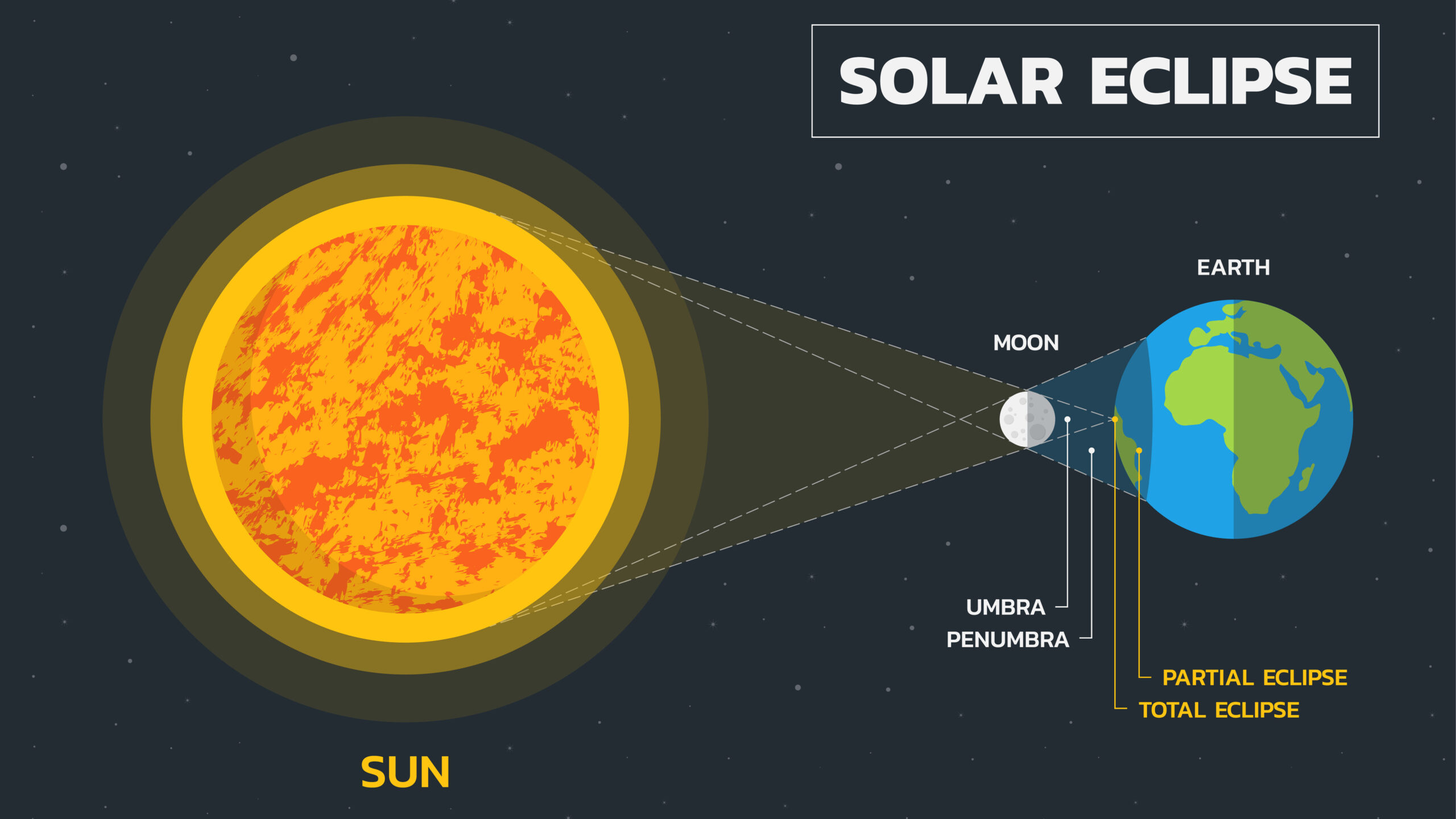
Alright, gather 'round, folks. I've got a tale to tell about the celestial dance that leads to the most dramatic fashion show in the sky - a solar eclipse. Now, don't go thinking this is some sort of celestial catwalk where the Sun struts its stuff in the latest designer shades. No, no, no. This is serious business, and it only happens under very specific conditions. So, grab your snacks, get comfy, and let's dive in.
First things first: The Players
We've got three main characters here: the Sun, the Moon, and the Earth. Now, I know what you're thinking, "But I thought the Sun was the star of the show!" Well, yes, it is, but today, it's playing the role of the humble backdrop. The real stars of this show are our trusty Moon and dear old Earth.
Meet Luna, the Moon
Our Moon is like the ultimate diva of the solar system. She's got her own gravitational pull, she's responsible for those beautiful tides that keep our beaches so lovely, and she's got a penchant for drama. She's the one who's going to steal the show today, but more on that later.
Must Read
And This is Our Earth
Now, Earth, she's the hostess with the mostest. She's the one who's going to make sure everything runs smoothly. She's got a big job ahead of her, so let's give her some love, yeah?
Now, the Conditions
Alright, so what exactly needs to happen for our lunar diva to steal the spotlight? Well, it's all about timing, location, and a bit of celestial geometry. Let's break it down.
Timing is Everything
First up, we need to be in the right place at the right time. You see, the Moon orbits the Earth once every 27.3 days or so. That's right, folks, our Moon is a bit of a commitment-phobe. But when she's in the right spot, she can create some serious magic.
Now, every year, there are about two solar eclipses. But here's where it gets interesting. These eclipses don't happen just anywhere. No, they're picky. They only occur along a narrow path on the Earth's surface, and that path changes with each eclipse. It's like the celestial equivalent of a surprise party - you never know where it's going to happen next!
Line 'Em Up
Next, we need a straight shot. The Sun, the Moon, and the Earth have to be in a straight line. This is called a syzygy, which is just a fancy word for 'when three things line up in a row.' It's like when you're trying to get a group photo and someone's always standing in the wrong spot. But up in space, everyone knows their place.
Now, this alignment happens all the time, but it's not until the Moon is in the right spot in its orbit that we get a solar eclipse. It's like waiting for the perfect moment to snap a photo - you've got to be patient.
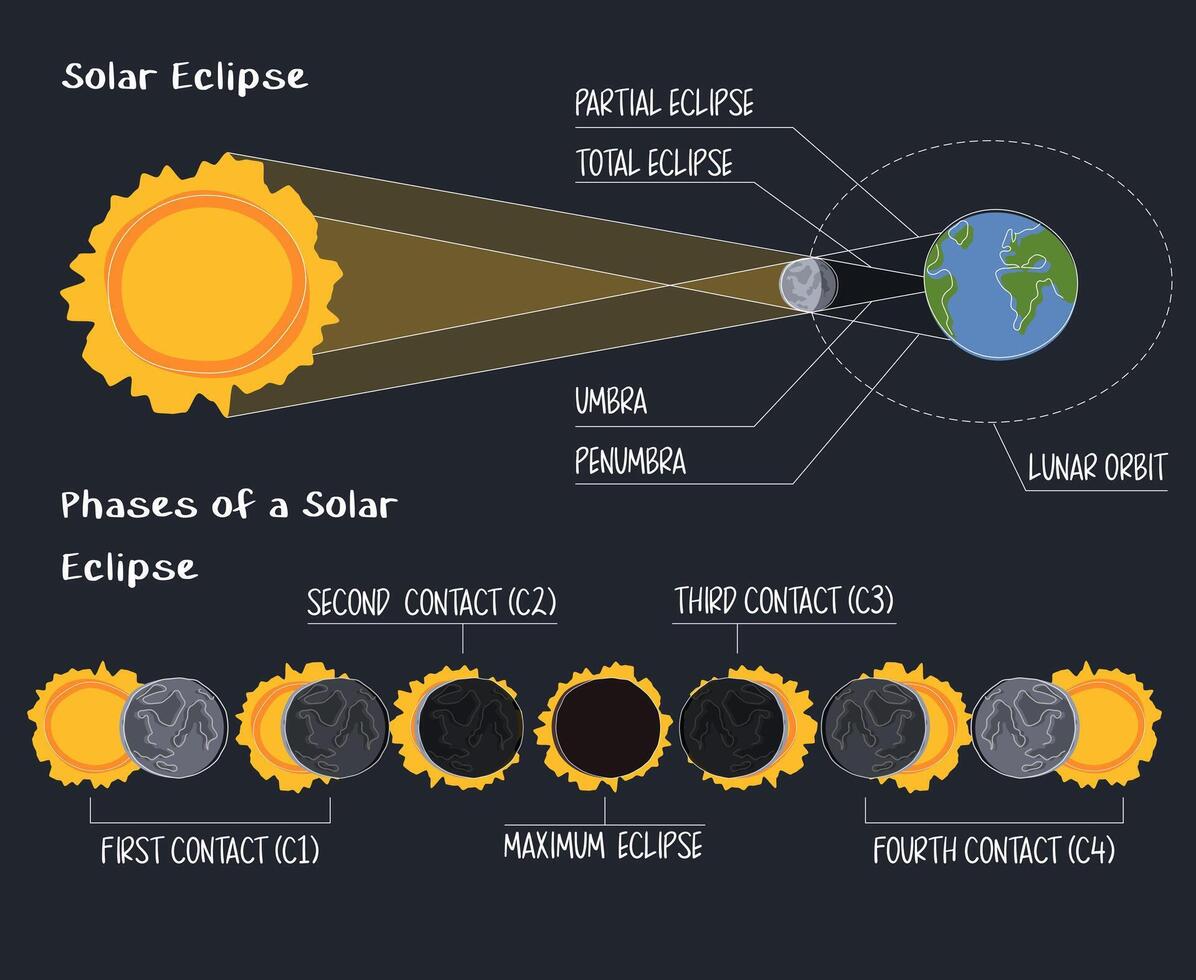 solar eclipse infografía. etapas de contacto de el la tierra satélite
Size Matters
Here's where the Moon really shows off. You see, the Moon is just the right size to block out the Sun completely. It's like she's wearing a giant pair of sunglasses - the biggest, blackest sunglasses you've ever seen. But here's where it gets crazy - the Moon is actually four hundred times smaller than the Sun, but it's also four hundred times closer to Earth. Isn't that just the weirdest coincidence?
So, when the Moon is in the right spot, it can block out the Sun completely, casting a shadow over the Earth. But here's where it gets even weirder - the Moon's shadow is actually four times bigger than the Moon itself. It's like she's casting a giant, dramatic silhouette of herself across the sky. Talk about an ego boost!
And Then... Darkness Falls
So, there you have it. When all these conditions are met, we get a solar eclipse. It's a rare, magical moment where the Moon takes center stage, and the Sun takes a backseat. It's like the ultimate celestial photoshoot, and we get to be the ones snapping the pictures.
But remember, folks, solar eclipses are serious business. You've got to protect your eyes, and you've got to respect the power of the Sun. Don't go looking directly at it, even when it's all covered up. That's like looking at a camera flash - it's not worth the risk.
So, the next time you hear about a solar eclipse, you'll know just what's going on up there. It's a celestial dance, a delicate balance of timing, location, and size. And when it all comes together, we get a show that's out of this world.
Until next time, folks. Keep your eyes on the sky, and remember - the Moon might be a diva, but she's our diva. And we love her for it.
