What Are The Three Stars In A Row Called

Alright, settle in, stargazer newbie. You’ve looked up at the night sky, maybe after your third iced latte, and noticed them: three bright stars, perfectly lined up like a cel...
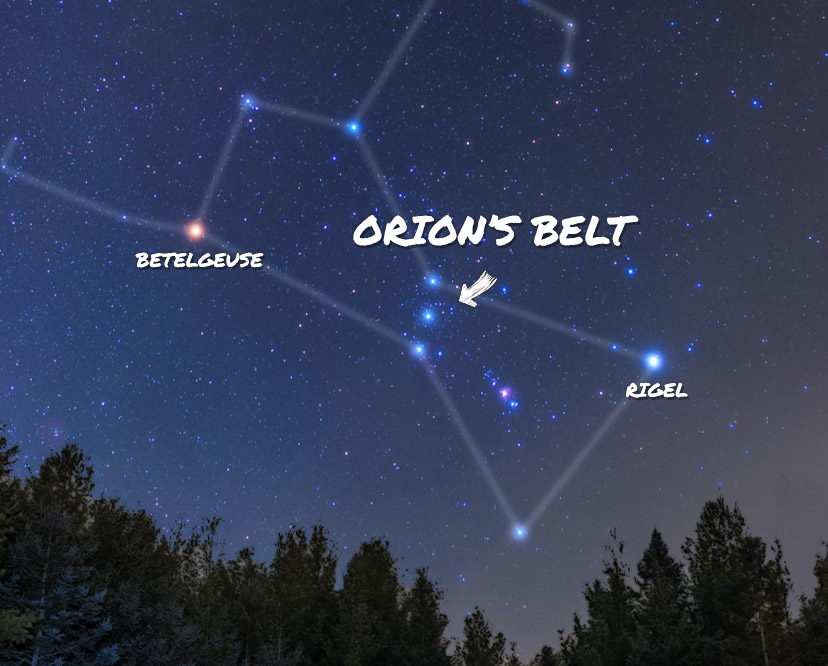
Alright, settle in, stargazer newbie. You’ve looked up at the night sky, maybe after your third iced latte, and noticed them: three bright stars, perfectly lined up like a celestial string of Christmas lights. Your brain, fried from doom-scrolling, screams, “What are those things? The McDonald's arches in space?” You are not far off, but the answer is way cooler than a burger.
What you are looking at is Orion’s Belt. Yes, that Orion. The hunter guy with the sword and the temper. This trio is his belt, not his tie, not his suspenders, but the fashion accessory that holds his cosmic trousers up. It’s the most famous asterism—that’s space-nerd for “a recognizable pattern of stars that isn’t a whole constellation”—in the entire sky.
Now, before you think you’ve discovered something new, every ancient culture on Earth spotted this lineup. The Egyptians thought the stars marked the gateway to the afterlife and built the Pyramids of Giza to perfectly mirror their positions. I’m not kidding. They basically looked at the sky and said, “Let’s build a massive stone copy of that belt, but, you know, on a Tuesday.” Talk about an architectural flex.
Must Read
Their Actual Names Sound Like Fantasy Characters
The three stars are named Alnitak, Alnilam, and Mintaka. Say those five times fast after a glass of wine. They come from Arabic, meaning “the girdle,” “string of pearls,” and “the belt.” Basically, the ancients were very focused on the accessory. If you ever name a rock band, use “Alnilam & The Mintakas.” You’re welcome.
But here’s the wild part: They aren’t actually close to each other. They look like three buddies in a row, but they’re a big, fat optical illusion. Alnitak is 800 light-years away, Alnilam is about 1,340 light-years from Earth, and Mintaka is around 900 light-years out. They are millions of miles apart in real space. It’s like seeing three streetlights on a highway and assuming the drivers are all holding hands. They are not. They are just lined up from our very lucky viewpoint.
Fun fact: All three are absolute monsters. Each one is a supergiant star, meaning they burn hotter and brighter than our puny Sun. Alnilam, the middle star, is a blue-white hell-beast that is roughly 275,000 times more luminous than our Sun. If it were where our Sun is, Earth would be vaporized before you could say “sunscreen.” So please, do not point a telescope at it and wink.
 2,348 Three Stars In A Row Stock Photos, High-Res Pictures, and Images
What About Other “Three In A Row” Patterns?
People get confused. They see three stars in a row near the Big Dipper and think, “Is that another belt?” No. That is usually the handle of the Big Dipper (which is actually an asterism itself, inside the constellation Ursa Major). Or sometimes, you’ll see a horizontal line of three stars near the constellation Cygnus the Swan. That is the Swan’s Wing bones, or as astronomers call it, “the tinier, less famous belt.”
But the only trio that gets a capital-letter “Three Stars In A Row” with a Wikipedia page is Orion’s Belt. It is the VIP section of the Milky Way. Everyone else is just standing in line for the bathroom at a dive bar.
Why Should You Care?
Because using this knowledge makes you sound like a genius at a party. Next time you’re at a backyard barbecue and someone says, “Look, three stars in a row,” you drop the hammer: “That’s Orion’s Belt. You know the Great Pyramid aligns with the second one, Alnilam? Also, all three are dying supergiants that will eventually go supernova. Pass the potato salad.”
 Premium Vector | Three stars are shown in a row with the middle star
You’ll get nods of respect. Someone might even ask you to explain dark matter. Do not. Stick to the belt. It’s your safe space. Also, Orion is visible from almost everywhere on Earth during winter (or summer, if you’re in the Southern Hemisphere). So you have no excuse. Every clear night, that belt is up there, winking at you like three cosmic celebrities in a monster truck rally.
In summary: The three stars in a row are Alnitak, Alnilam, and Mintaka, collectively Orion’s Belt. They are not friends. They are not holding hands. They just happen to be lined up perfectly so that humans for thousands of years could point at them and say, “Nice pants, hunter.” Go outside, find them, and impress your dog. Your dog won’t care, but you’ll feel better.
And if anyone asks why they’re called a belt instead of a tie, just tell them Orion is a casual dresser. He doesn’t do neckwear. It’s the universe’s rule. Case closed.
