To The Moon And Back Distance

Have you ever told someone you’d love them “to the moon and back”? It’s a sweet phrase, right? But have you ever actually stopped to wonder what that distance really means? L...

Have you ever told someone you’d love them “to the moon and back”? It’s a sweet phrase, right? But have you ever actually stopped to wonder what that distance really means?
Let’s be real—we all throw that phrase around like it’s nothing. “I’d walk a thousand miles for you,” or “I love you to the moon and back.” But when you look at the numbers, it’s honestly kind of mind-blowing. What does that distance even look like?
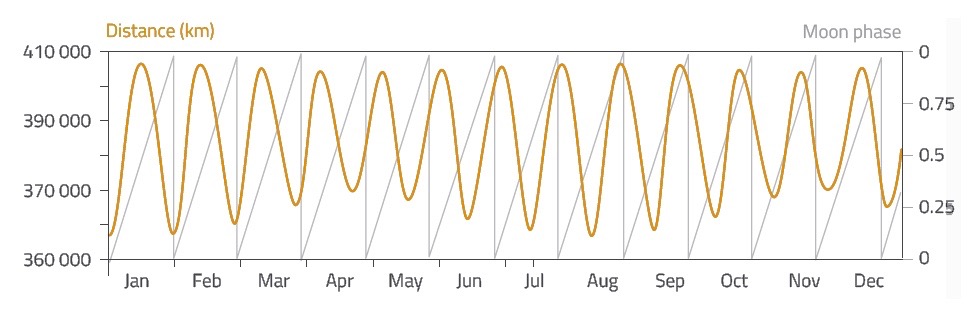
The average distance from Earth to the moon is about 238,855 miles. That’s almost a quarter of a million miles. Just let that sink in for a second.
Must Read
It’s not like hopping in a car for a road trip. If you drove at 60 miles per hour, non-stop, no bathroom breaks, it would take you over 165 days to get there. That’s nearly six months behind the wheel, just staring at the same road.
And you’d have to drive back to complete the promise. So, “to the moon and back” is really 477,710 miles. That’s almost half a million miles of pure, empty space.
Think about that the next time you say it to your mom or your best friend. You’re basically saying, “I’d do a marathon through the vacuum of space for you.” Pretty intense, huh?
Why the Moon’s Distance Is Weirdly Cool
Here’s where it gets fun. The moon isn’t sitting at a fixed spot like a lightbulb on a ceiling. It’s actually drifting away from us every single year. About 1.5 inches per year, to be exact.
So when you say “to the moon and back,” the distance is technically changing. If you said it to your partner ten years ago, you were promising a slightly shorter trip. It’s like the universe is messing with our romantic metaphors.
But let’s put that number into real-world terms. The distance from New York to Los Angeles is about 2,450 miles. You could make that drive 98 times and still not equal one moon trip. That’s a lot of gas station coffee.
How Big Is the Moon, Anyway?
We talk about the distance, but the moon itself is pretty huge. Its diameter is roughly 2,159 miles. That’s about the width of the entire United States.
 How To Measure Distance
So imagine picking up the whole USA, rolling it into a ball, and tossing it a quarter-million miles away. That’s basically what we’re looking at every night. Kinda makes you feel small, doesn’t it?
And here’s a fun brain teaser: you could fit all the planets in our solar system between Earth and the Moon. Yup, every single planet—Mercury, Venus, Mars, Jupiter, Saturn, Uranus, Neptune—could line up in that gap. With room to spare.
That’s insane. Think about that the next time you look up. There’s enough empty space out there to park a whole parade of planets.
Your Steps vs. Space Steps
Let’s talk walking. If you’re an average person with a stride of about 2.5 feet, you’d need to take roughly 504 million steps to reach the moon. That’s half a billion steps.
At a normal walking pace of 3 miles per hour, it would take you 9 years of non-stop walking. Forget blisters—you’d need a new pair of shoes every week for nine years.
And to come back? You’d be walking for 18 years total. That’s like walking from the day you’re born until you graduate college. Who are you promising this to—a superhero?
The Light-Speed Trick
Now, here’s the coolest part. Light travels at 186,282 miles per second. That means a beam of light from the moon reaches Earth in about 1.3 seconds.
 To the Moon and back: reflecting a radio signal to calculate the
So when you look at the moon, you’re actually seeing it as it was 1.3 seconds ago. You’re looking into the past. How wild is that?
Compare that to a cell phone delay. A 1.3-second lag is annoying on a video call, but for space? That’s practically instant. It’s the difference between a quick text and mailing a letter to another galaxy.
Why This Matters for Your Love Life
Okay, so back to that old saying. “To the moon and back” isn’t just a cute phrase—it’s a cosmic scale of commitment. You’re saying, “I’d travel half a million miles, through empty, freezing darkness, with no air, just to prove I care.”
That’s a lot heavier than a box of chocolates, right? It puts a little perspective on everyday arguments. If someone drives through traffic to see you, that’s nothing compared to 477,710 miles.
And here’s the secret: the moon’s distance is also a reminder of how vast and strange our universe really is. We live on a little blue marble, and our nearest neighbor is still a quarter-million miles away. That’s both humbling and thrilling.
So, What’s the Takeaway?
Next time you hear that line in a song or a movie, don’t just nod along. Pause for a second. Imagine the drive, the steps, the light delay, the planets fitting in the gap.
It’s a reminder that sometimes the simplest words hide the biggest wonders. The moon’s distance isn’t just a number—it’s a feeling. A feeling of awe, of connection, of how tiny we are in a gigantic, beautiful cosmos.
So go ahead, say it. “I love you to the moon and back.” Just know that when you do, you’re promising a journey that’s bigger than most of us will ever take. And that’s pretty darn cool.
