Substituting Baking Powder With Baking Soda

Picture this: you're knee-deep in a cake recipe, feeling like a culinary genius, when suddenly you realize you're out of baking powder. Gasp. Now, the internet tells you to ju...
:max_bytes(150000):strip_icc()/TC_607372-substitute-baking-powder-and-baking-soda-5abaaa97ba617700376d9fde.png)
Picture this: you're knee-deep in a cake recipe, feeling like a culinary genius, when suddenly you realize you're out of baking powder. Gasp. Now, the internet tells you to just grab the baking soda instead. What could possibly go wrong?
Well, everything. Or maybe nothing. Welcome to the beautiful chaos of baking substitutions, where chemistry meets comedy.
First, Let's Get One Thing Straight
Baking powder and baking soda are not the same thing, even though they sound like they might be related at a family reunion. Baking powder is basically baking soda's more polished, well-rounded cousin who always remembers to bring a gift department.
Must Read
Baking soda is pure sodium bicarbonate, a one-man show waiting for something acidic to react with. Baking powder already contains both the soda and the acid, so it shows up to the party ready to rise all by itself.
Think of it this way: baking soda is a cold start car that needs you to pump the gas. Baking powder walks in and says, "I got this," and immediately fires up.
The Golden Rule You Absolutely Need to Know
If you swap baking powder for baking soda, you must use about one-third the amount. So if a recipe calls for a teaspoon of baking powder, you're reaching for roughly one-quarter teaspoon of baking soda.
Why so much less? Because baking soda is about three times more powerful. Using too much of this stuff is like trying to inflate an air mattress with a leaf blower — technically impressive, but practically disastrous.
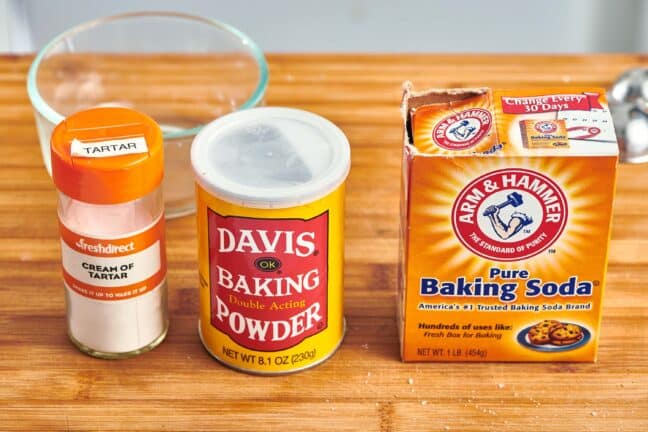 How to Substitute Baking Soda and Baking Powder — The Mom 100
Too much baking soda leads to a soapy, bitter, metallic taste that your taste buds will never forgive you for. Your cake will rise dramatically, then collapse in shame.
But Wait, There's More — Acidity!
Here's where most bakers trip over their aprons: baking soda needs an acid to activate. Without one, it just sits there doing absolutely nothing, like me on a Monday morning.
You'll need to add something sour to your recipe — think buttermilk, yogurt, lemon juice, vinegar, or sour cream. These acids are the fuel that lights baking soda's explosive little fireworks.
If your recipe already contains a gap-filling acidic ingredient, you're golden. If it doesn't, you absolutely must introduce one to the batter or you'll end up baking a flat, dense brick.
Let's Talk Numbers, People
Here's a quick cheat sheet: 1 teaspoon of baking powder equals roughly ¼ teaspoon of baking soda plus an acid. That's the swap you'll make about 90% of the time in regular recipes.
 what is a substitution for baking powder - Cooking with alternative
In an acidic recipe — say, one loaded with buttermilk or brown sugar — you might only use a pinch (⅛ teaspoon) of baking soda. Seriously, it's powerful enough to leave even seasoned bakers blinking.
Meanwhile, if you ever find yourself desperate and need to go the other direction? For every ¼ teaspoon of baking powder, use 1 teaspoon baking soda plus 1½ teaspoons cream of tartar. I know. The math is giving me headaches too.
Unexpected Joys and Lethal Mistakes
The cool thing about baking soda is that it actually helps with browning. Your cookies and breads can develop a gorgeous golden color thanks to an alkaline reaction called Maillard browning.
But the not-so-cool thing? Overdoing it creates a bitter, almost chemical aftertaste that makes people question your life choices. And yes, your grandma will absolutely notice.
Fun fact: professional bakers sometimes use baking soda's power for pizzas, pretzels, and bagels to achieve that perfect crispy, deeply browned exterior. So it's not just a kitchen hack — it's an actual craft.
 Can You Use Baking Powder Instead Of Baking Soda? Find Out!
The Verdict: Should You Even Bother?
If you're out of baking powder, use baking soda with confidence — just scale it down and bring an acid friend. It's a perfectly respectable kitchen rescue mission.
But if you have the choice, always prefer what the recipe asks for. Recipes are precision instruments, not suggestions.
Bottom line? Baking powder and baking soda are totally interchangeable if you respect their differences. One is the overachieving teammate; the other is the wild card.
Treat them like they're the same, and you'll get a hockey puck pretending to be a muffin. Respect the swap, and your treats will rise like the heroes they were always meant to be.
And remember: when in doubt, just bake it twice. The first batch is insurance, and the second is therapy. Happy baking!
:max_bytes(150000):strip_icc()/TC_607372-substitute-baking-powder-and-baking-soda-5abaaa97ba617700376d9fde.png&description=Substituting+Baking+Powder+With+Baking+Soda)