Ruby On Rails Interview Questions 2019

Rails in the Spotlight: Your 2019 Interview Guide Alright, tech enthusiasts, let's dive into the world of Ruby on Rails. You've got your resume polished, your portfolio shini...
Rails in the Spotlight: Your 2019 Interview Guide
Alright, tech enthusiasts, let's dive into the world of Ruby on Rails. You've got your resume polished, your portfolio shining, and now it's time to brush up on those interview questions. We've got you covered with a fun, engaging guide that'll make you feel like you're sipping lattes with the Rails crew, not sweating bullets in a stuffy office.
First Things First: The Basics
Let's start with the basics, like that time you learned to ride a bike. You've got to master the fundamentals before you can show off your tricks. So, what's Rails all about?
Rails is a web application framework written in Ruby, a programming language that's as smooth as a Barry White ballad. It's all about convention over configuration, which means Rails comes with a bunch of default settings that make development faster and easier. It's like having a personal assistant that knows exactly what you need before you even ask.
Must Read
Here's a fun fact: Rails was created by David Heinemeier Hansson (DHH) in 2005, and it's open-source, which means it's free to use and has a big, loving community behind it. It's like the Linux of web development - everyone's welcome to contribute and make it better.
Getting Down to Business: The Interview Questions
Now that we've got the basics down, let's talk about those interview questions. We've gathered some of the most common ones, along with tips on how to answer them like a pro.
What's the difference between a scaffold and a resource in Rails?
This one's a breeze. A scaffold is a full set of CRUD (Create, Read, Update, Delete) views and controllers generated by Rails. It's like a pre-made blueprint for your app. On the other hand, a resource is just a route and a controller, with no views. It's more like a blank canvas for you to create your own masterpiece.
Can you explain the Rails request-response cycle?
Sure thing! Here's a simple breakdown: When a user requests a page, Rails goes through a series of steps to generate a response. It starts with the router, which matches the request to a controller action. Then, the controller handles the request, interacts with the model (the brains of your app), and passes the response back to the view (the face of your app). Finally, the view renders the response, and Rails sends it back to the user's browser. It's like a well-choreographed dance, with each part playing its role.
How would you handle validation in Rails?
Validation is all about making sure your data is clean and consistent. In Rails, you can use built-in validations like required, numericality, and presence. You can also create custom validations for more complex rules. Here's a tip: Always validate on the model, not the controller. It keeps your code DRY (Don't Repeat Yourself) and makes your app more maintainable.
 51 Ruby on Rails Interview Questions - Adaface
Bonus Round: The Tricky Ones
These questions might catch you off guard, but don't worry - we've got your back.
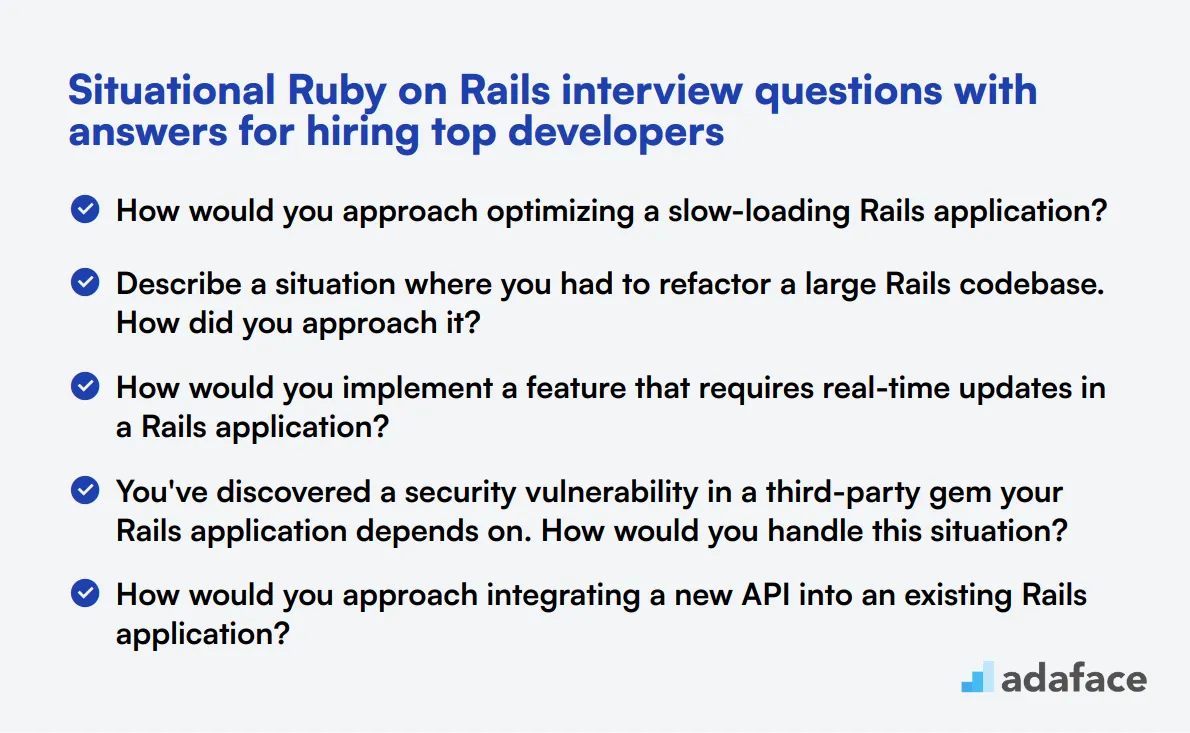
How would you optimize a slow Rails app?
There are tons of ways to speed up a slow Rails app. You could start by profiling your app with tools like New Relic or Skylight to find bottlenecks. Then, you could optimize your database queries, use caching to store expensive operations, or even consider using a background job processor like Sidekiq or Resque for heavy tasks.
Can you explain the difference between STI and MTI in Rails?
Sure thing! STI stands for Single Table Inheritance, which means you can create a hierarchy of models that share a single database table. It's great for when you have a parent-child relationship, like a 'Book' model with 'Paperback' and 'Hardcover' children. MTI, on the other hand, stands for Multiple Table Inheritance. It's like STI, but each model has its own table. It's useful when you have models that share some common columns, but also have unique columns of their own.
Reflection Time: Rails in Daily Life
So, you've aced your interview and landed your dream job. But how does Rails fit into daily life? Well, it's everywhere. From the apps on your phone to the websites you visit, Rails is powering some of the biggest and best-known platforms out there. It's a testament to the power of open-source software and the community that supports it.
But Rails isn't just about the big guys. It's also about the little things - the startups, the side projects, the weekend hackathons. It's about the joy of creation, the thrill of solving problems, and the satisfaction of seeing something you've built come to life. So, here's to you, the Rails developer. Keep building, keep learning, and most importantly, keep having fun.
