Is Tension Measured In Newtons

So, you’re sitting there, maybe sipping an overpriced triple-shot latte, and a question pops into your head: “Is tension measured in Newtons?” It sounds like the kind of thing...
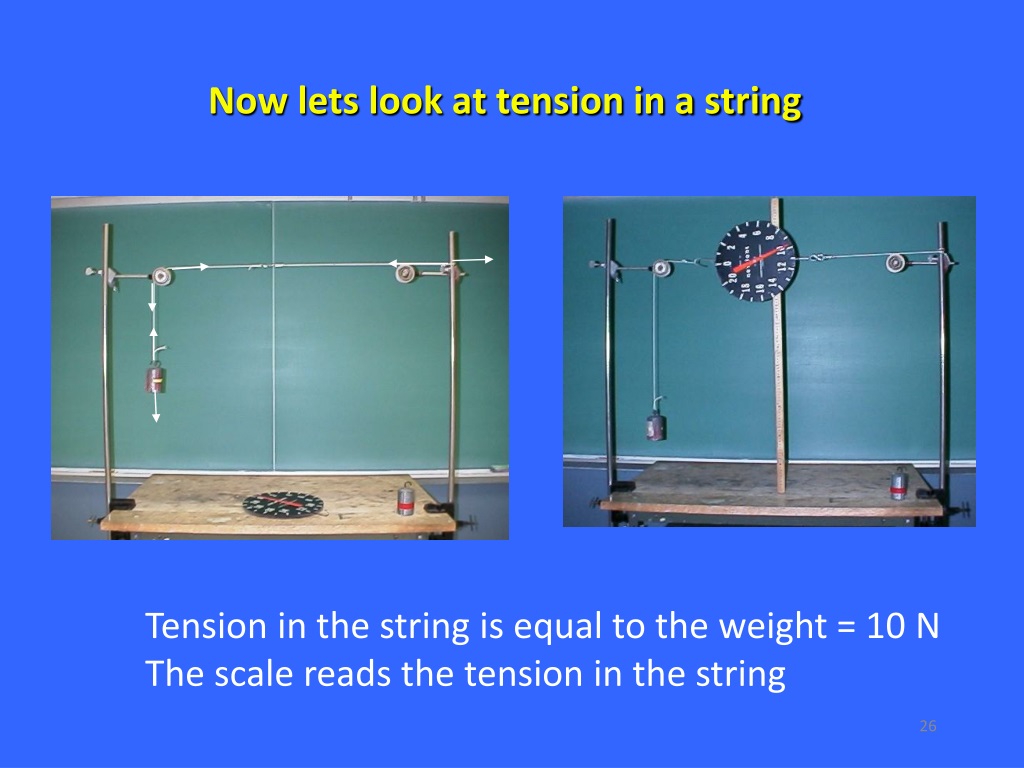
So, you’re sitting there, maybe sipping an overpriced triple-shot latte, and a question pops into your head: “Is tension measured in Newtons?” It sounds like the kind of thing a physics professor might mumble into their beard while adjusting their pocket protector. But I promise, this is not as boring as that sentence made it sound. In fact, it’s about to get hilariously specific.
Let’s cut to the chase: yes, tension is measured in Newtons. A Newton—named after the apple-obsessed Sir Isaac—is the force needed to make a one-kilogram object accelerate at one meter per second squared. Basically, it’s the universe’s unit for “push” and “pull.” And tension? That’s just a fancy word for “pull” happening inside a string, rope, or cable, like when your dog sees a squirrel and your arm becomes a human tug-of-war.
Now, you might be thinking, “Wait, doesn’t ‘tension’ sound like the feeling I get before a deadline or a family dinner?” That is a different kind of tension, and mercifully, it is not measured in Newtons. If it were, my aunt’s passive-aggressive comments would have a reading of, like, 500 billion Newtons—enough to launch a small car into orbit. But alas, emotional stress uses different units: wine glasses, eye rolls, and sudden interest in checking your phone.
Must Read
Why Newtons Matter (and Why Your Gym Rope Cares)
Imagine you’re at the gym, doing cable curls like a respectable human being. That cable is under tension, and if it couldn’t handle a certain number of Newtons, it would snap—and you’d send a weight plate flying into a guy on the treadmill. That is why engineers obsess over Newtons: they prevent your workout from becoming a Final Destination scene.
Here’s a fun fact that will make you look smart at parties: one Newton is roughly the weight of a medium-sized apple. So when you pull on a rope with 10 Newtons of force, you’re essentially dangling ten apples from your grip. Does that help you visualize tension? No? Well, it’s still fun to say: “This bungee cord handles 2,000 Newtons, which is like lifting a giant produce section.”
But here’s where it gets weird: tension is a scalar measurement of force along a line. That means it doesn’t matter if you’re pulling left, right, or up—it’s still Newtons. So if your friend says, “I feel tension in the air,” they are scientifically incorrect. Unless they’re literally holding a rope in a crowded room, in which case, congratulations—they’re a physicist now.
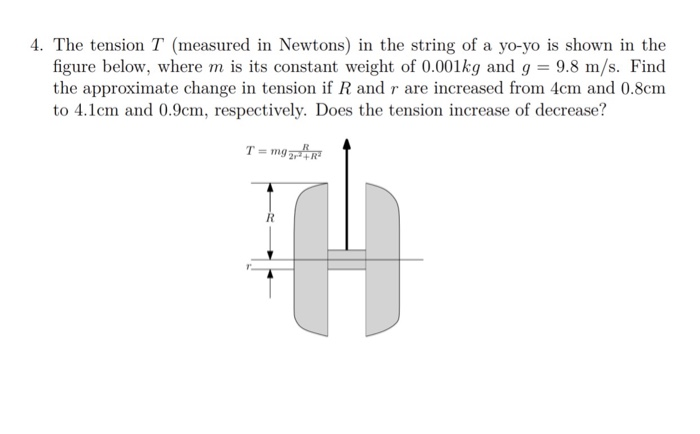 Solved 4. The tension T (measured in Newtons) in the string | Chegg.com
The Surprising Truth About Cats and Tension
Let me blow your mind: a housecat, when relaxed, weighs about 40 Newtons. But when a cat is about to pounce on a laser pointer, the tension in its leg muscles spikes to over 100 Newtons for a split second. That’s like suddenly carrying a small refrigerator on your paws. Cats are living tension dynamos, and they use Newtons without even knowing algebra.
In the real world, tension in a simple rope is the same everywhere—assuming no friction and zero-mass rope (physics loves imaginary perfect things). So if you’re pulling a sled with 50 Newtons, every inch of the rope feels that same 50 Newtons. It’s like a group chat where everyone gets the same annoying meme: uniform tension. Don’t you wish human relationships worked that way?
Now, brace yourself for a truly pointless but awesome fact: the tension in a taut guitar string is about 80 to 100 Newtons. That’s roughly the force of holding up a large bag of dog food. So when a rock star shreds a power chord, they’re literally fighting a bag of kibble with their fingertips. Rock and roll, baby.
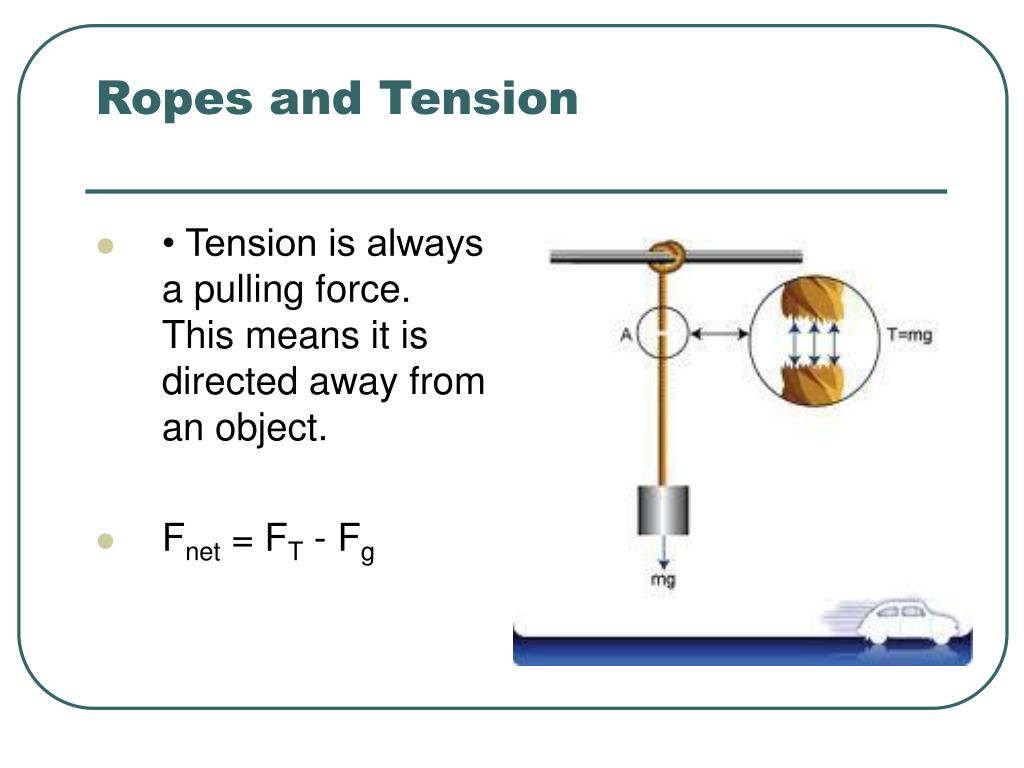 PPT - Newton’s Third Law PowerPoint Presentation, free download - ID
Why You Should Care (Even If You Hate Math)
Look, you don’t need to calculate Newtons to enjoy life. But knowing that tension is measured in them gives you superpowers. For example, when someone says, “This bridge can handle a lot of tension,” you can smugly ask, “How many Newtons, specifically?” They will either be impressed, or they will avoid you at parties. Both outcomes are fine.
And let’s be honest: using the word “Newtons” makes you sound like a genius. You could say, “My shoelace is under only about 5 Newtons of tension, but my patience for this meeting is under negative infinite Newtons.” See? Instant humor + science cred. It’s like punning, but with more gravitational implications.
So next time you see a rope, a cable, or even a stretched elastic band, remember: behind every good pull is a Newton having a quiet, heroic moment. And if anyone tries to tell you tension is measured in pounds or kilograms, feel free to correct them—but only if you’re wearing a lab coat. Or a cat. The cat gives you authority.
In conclusion, yes: tension is measured in Newtons. It’s the force of pulls, of stretches, of that moment when you’re trying to open a stubborn jar lid and your face goes red. And if that isn’t a perfect metaphor for life, I don’t know what is. Happy pulling.
