Is It Safe To Leave Cooked Chicken Out Overnight

You know that moment. You’re about to crash after a big dinner, and there’s a plate of leftover chicken just sitting on the counter. The fridge is a whole ten steps away, and...

You know that moment. You’re about to crash after a big dinner, and there’s a plate of leftover chicken just sitting on the counter. The fridge is a whole ten steps away, and your bed is calling your name. Can’t I just deal with this in the morning? It’s such a tempting thought, isn’t it?
Before you hit the pillow, let’s chat about what’s really happening to that chicken. We’re not here to judge, just to get the facts straight. The short answer is a hard no — it’s not safe to leave cooked chicken out overnight. But the “why” behind that rule is actually pretty fascinating.
The Great “Danger Zone” Adventure
Picture a thermometer for a second. The “danger zone” for food is between 40°F and 140°F. This is the sweet spot where bacteria throw a party. Cooked chicken, sitting at room temperature (say, 68°F or so), is smack-dab in the middle of that zone.
Must Read
It’s not about the chicken “going bad” in a visual way overnight. It’s about tiny invisible guests showing up. Bacteria like Staphylococcus aureus and Salmonella love room-temp chicken more than we love a lazy Sunday morning. They can double in number every twenty minutes.
Do the math: leave that chicken out for eight hours, and a single bacterium becomes a crowd of millions. That’s like inviting a handful of friends over, only to wake up to a stadium full of strangers. Your stomach definitely doesn’t want that kind of party.
Why “Just One Night” Feels So Safe
Our brains play tricks on us. The chicken still looks good, right? It smells fine, maybe even a little fragrant. Your mind says, Hey, people left food out for centuries before fridges! And you’re not wrong — people did.
But here’s the twist: our modern kitchens and chicken are different. Factory-processed chicken has a different bacterial load than a fresh-killed bird from a farm market. Plus, we cook it to a safe internal temperature (165°F), but that doesn’t sterilize the air around it. Once it cools, the bacteria that survive just get a second wind.
Think of it like leaving a half-eaten cupcake on the porch. The ants will find it eventually, even if you don’t see them at midnight. Bacteria are those ants, just smaller and way more efficient.
The Two-Hour Rule Is Your BFF
Food safety folks have a simple golden rule: don’t leave cooked chicken out for more than two hours. If the room is above 90°F (like a hot summer day), that window shrinks to just one hour. Why? Because bacteria are turbo-charged by warmth.
Overnight is roughly eight to ten hours. That’s four to five times the recommended limit. It’s like leaving your phone in the rain for a full day instead of just a quick drizzle. The difference isn’t subtle — it’s a total soak.
You might be thinking, “But I’ll reheat it in the morning! That kills everything, right?” Not quite. Reheating can kill live bacteria, but it doesn’t destroy the toxins they left behind. Those toxins are like little poison time-bombs that heat can’t neutralize. Your microwave can’t un-ring that bell.
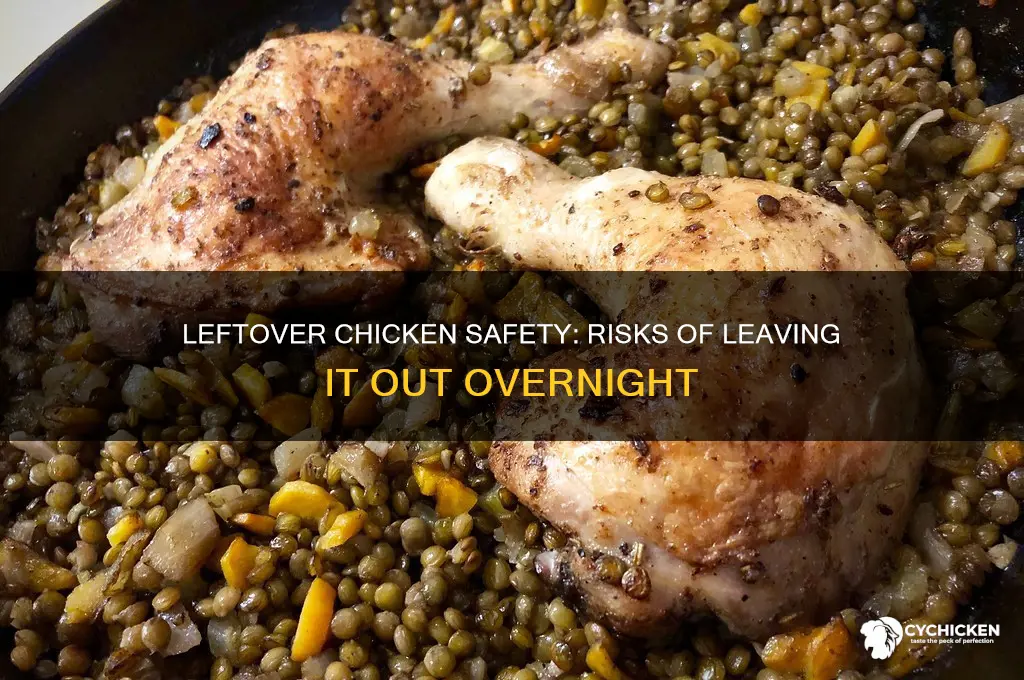 Leftover Chicken Safety: Risks Of Leaving It Out Overnight | CyChicken
When In Doubt, Toss It Out
There’s a chill, easy way to handle this: if you’re asking the question, you already know the answer. Your gut (pun intended) is telling you it’s risky. That little voice is your survival instinct wrapped in common sense.
Instead of gambling with your digestive system, make a pact with yourself. Before you sit down to eat, prep a container. Scoop the leftover chicken into the fridge the moment you stand up. It takes fifteen seconds and saves you a world of regret later.
Think of it like locking your front door before bed. You don’t expect an intruder, but you do it anyway because the risk isn’t worth the convenience. Leaving chicken out is like leaving your door wide open for microscopic troublemakers.
A Fun Comparison: Chicken vs. Cheese
Here’s a weird but interesting thought: hard cheese can sit out for a while. Cheddar or Parmesan can hang at room temp for hours without drama. Why? Because they have low moisture and high acidity — bacteria don’t like that environment.
Cooked chicken is the opposite: high moisture, neutral pH, and full of protein. It’s basically a luxury resort for microbes. They check in, eat, and multiply like it’s spring break in Cancún. That’s why the rules are so different for different foods.
So no, you can’t apply “cheese logic” to chicken. They’re not the same species of snack. One is a hardy survivor; the other is a fragile diva that needs constant climate control.
The Bottom Line, Made Simple
Look, I’m not here to scare you. Statistically, you might eat that overnight chicken and feel totally fine. People do it all the time. But it’s a dice roll, and the odds aren’t in your favor. Food poisoning is miserable — cramps, chills, and a bathroom that becomes your best friend.
Food safety is really just a game of probability. You’re playing against time and tiny organisms. Leaving chicken out overnight is betting you’re lucky. But why bet with your body when you can just open the fridge door?
Be kind to future-you. Wrap it up, chill it down, and sleep easy. Your chicken will be there in the morning, safe and sound — and ready for a delicious lunch.
