Is Diameter The Same As Width

There’s something oddly satisfying about untangling a simple question that pops up in everyday life, and "Is diameter the same as width?" is a perfect example. It’s a question...
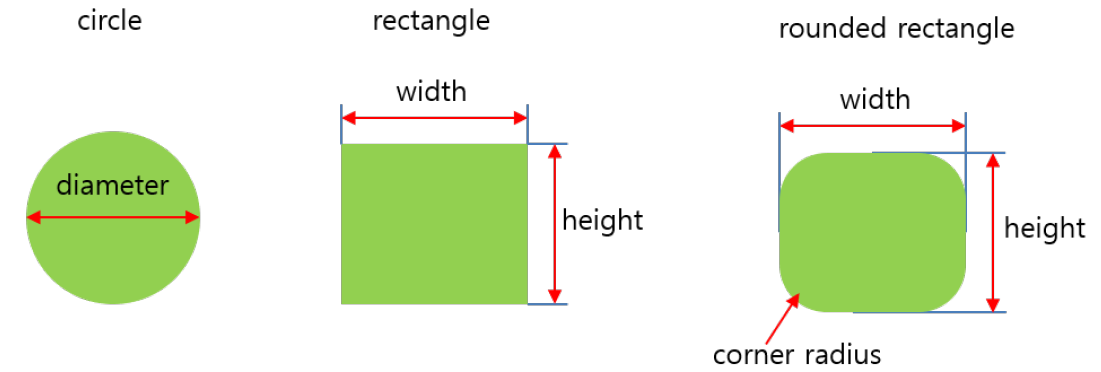
There’s something oddly satisfying about untangling a simple question that pops up in everyday life, and "Is diameter the same as width?" is a perfect example. It’s a question that feels practical, almost nostalgic—like realizing you’ve been using the wrong word for a circle all along. For DIYers sketching a tabletop, tailors measuring a round cushion, or even kids learning geometry, this distinction makes life easier. The main purpose here is clarity: understanding that while both terms describe a straight-line distance across an object, they apply to different shapes and contexts. Getting it right saves you from ordering a too-small pizza or cutting a crooked circle. It’s a tiny knowledge win, but a genuinely useful one.
At its core, diameter is a specialized term reserved for perfect circles and spheres. It refers to any straight line that passes through the center and touches two opposite points on the edge. Think of a round clock face: the line from 12 o’clock to 6 o’clock is its diameter—but so is the line from 3 to 9, as long as it goes through the center. Width, meanwhile, is a more flexible, general concept. It typically means the shortest side or distance across an object, especially a rectangle or irregular shape. A bookshelf’s width is its horizontal span, while its diameter makes no sense unless it’s perfectly round. So, for a circle, the width and diameter can be the same number, but you’d still call it the diameter to be precise.
Where things get delightfully muddled—and where most people get tripped up—is with round-but-not-quite-perfect objects. For instance, a car steering wheel or a dinner plate is essentially circular, so its width is its diameter. But take an oval, like a rugby ball: its longest width (the major axis) is not a diameter because it doesn’t have a true center. Similarly, a tree trunk might be measured by its diameter for lumber, but its width (if lopsided) could be slightly different. Example: A standard shipping tube for posters has a diameter of 2 inches, so its width (if laid flat) is also 2 inches—perfect for guessing if your poster will slide in smoothly.
Must Read
The real-world payoff comes when you’re shopping or building. Ordering a round rug? Know its diameter to see if it fits your floor space. Measuring a rectangular window for curtains? Use width—never diameter. Pro tip: If you see a “width” listed for a circular table online, assume the seller means diameter, but always double-check with a ruler or call to avoid a tiny or oversized surprise. For irregular shapes like an oddly curved vase, stick with “width” at the widest point, and don’t force the word diameter.
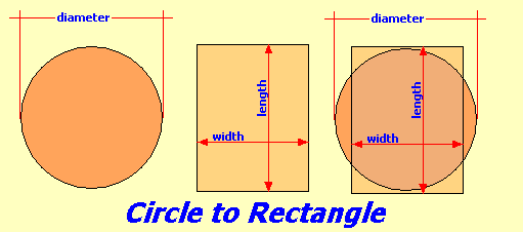 Converting A Circle into a Rectangle
How can you make this easy? Start by identifying the shape first. Is it a true circle or sphere? Then diameter is your keyword. Is it a rectangle, oval, or any other form? Use width. A simple hack: visualize a yarn string across the middle. If it must pass through a single central point to be measured correctly, you’re dealing with diameter. If you’re just measuring side to side, it’s width. Common variation: In woodworking, “width” often refers to a board’s smaller face, while “diameter” is reserved for dowels or round legs—so a 1-inch dowel has a diameter of 1 inch and a width of 1 inch (because it’s round), but a 1x4 board has a width of 4 inches (not diameter).
To wrap it up, diameter and width are not always the same, but they can overlap when the object is a perfect circle. The beauty of this distinction is that it makes you a more attentive measurer—someone who notices shapes and spaces with newfound clarity. Actionable takeaway: Next time you measure a round object, proudly say “diameter” and watch your confidence grow. For everything else, width will do just fine. It’s a small habit that turns a fuzzy idea into a precision tool, whether you’re hanging a mirror, buying a pizza, or just settling a debate with a friend.

