How Many Miles Is It To The Moon And Back

Have you ever looked up at the moon on a clear night and wondered, “How far away is that thing, really?” It feels close enough to touch, like a giant nightlight just out of re...

Have you ever looked up at the moon on a clear night and wondered, “How far away is that thing, really?” It feels close enough to touch, like a giant nightlight just out of reach. But the truth is, it’s a lot farther than you’d think.
When someone says “to the moon and back,” it sounds poetic, right? Like a promise of great distance. But what does that actually look like in miles?
Let’s break it down into numbers that actually mean something.
The average distance from Earth to the moon is about 238,855 miles. That’s the one-way trip. So, there and back? Double it. We’re talking roughly 477,710 miles.
Must Read
That number is so huge it almost feels fake, doesn’t it? Your brain kind of glazes over at “four hundred seventy-seven thousand.” Let’s try to make it feel more real.
Imagine you’re driving your car on a road trip. If you drove at a steady 60 miles per hour—no traffic, no bathroom breaks—it would take you about 166 days to get to the moon. And then another 166 days to get back.
That’s a whole year of driving, almost non-stop. You’d need a lot of snacks and a very patient co-pilot.
Now think about how fast an actual spaceship moves.
Apollo astronauts zipped along at about 25,000 miles per hour. That’s unimaginably fast, yet it still took them three days to reach the moon. Three days of just staring out a tiny window at black nothingness.
If you think about it, the moon is like a distant island in a cosmic ocean. The trip there and back is a voyage across a sea that’s 477,710 miles wide.
Here’s a fun comparison: the Earth’s circumference is about 24,901 miles. So “to the moon and back” is 19 laps around the entire planet. Imagine driving around the world 19 times. Your car would need, like, a million oil changes.
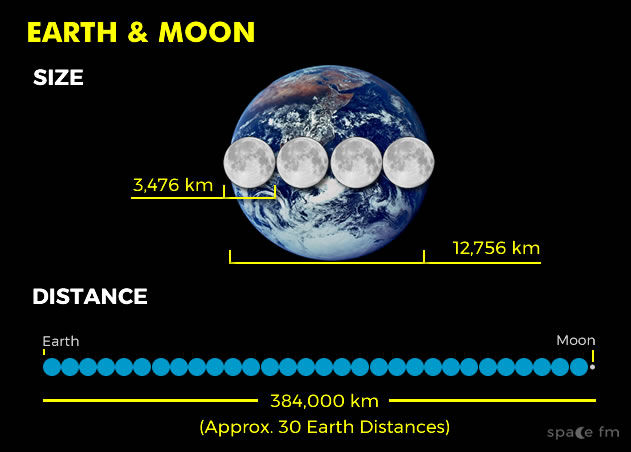 Moon In Relation To Earth Size
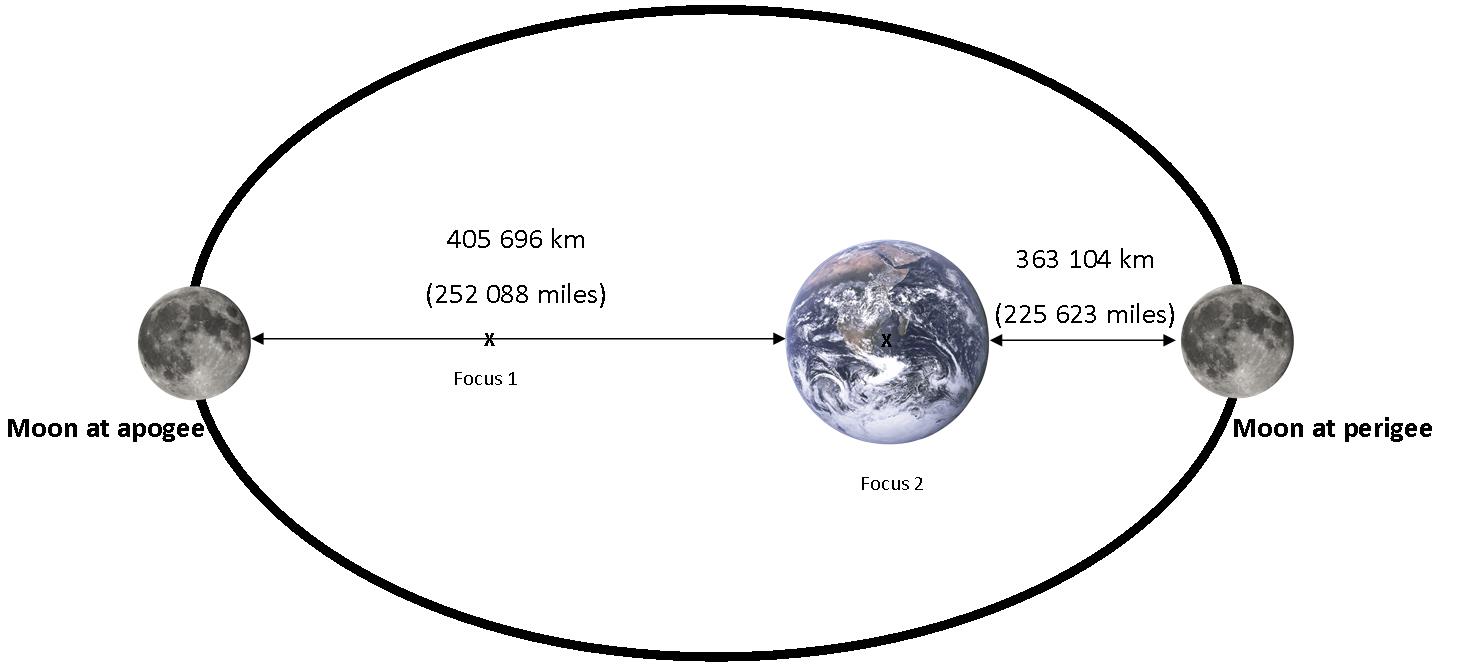
But the coolest part? The distance changes all the time.
The moon doesn’t orbit Earth in a perfect circle. It’s more of a squashed oval shape. So sometimes it’s closer—about 225,623 miles—and sometimes it’s farther—about 252,088 miles.
That means “to the moon and back” can vary by over 50,000 miles. That’s like adding or removing a trip from New York to Tokyo from your journey. Just because the moon felt like drifting a little.
When the moon is at its closest point, we call it a supermoon. It looks bigger and brighter. It’s also the most efficient time to send a rocket, because you’re saving about 26,000 miles each way.
Why does any of this matter? Because it’s humbling.
We sit on this little blue marble and casually say “I love you to the moon and back.” But we’re talking about a distance so vast that light itself takes 1.3 seconds to cross it. One point three seconds for the fastest thing in the universe.
Radio waves, which travel at the speed of light, need that 1.3 seconds to get from Earth to the moon. So if you yelled at an astronaut up there, they wouldn’t hear you for almost three seconds. That’s an awkward pause in any conversation.
And yet, humans have actually been there. We’ve stood on that dusty surface and looked back at us. Twelve people have walked the 477,710 miles round trip.
 How far away is the Moon? Distance between Earth and Moon explained
Think about that the next time you complain about a 45-minute commute. Those astronauts packed their bags for a three-day trip to a rock a quarter-million miles away. And they came back.
Here’s where it gets really mind-bending.
The phrase “to the moon and back” isn’t just about literal distance. It’s about impossible effort. It’s a way of saying, “I would go as far as a human can possibly go, just to return to you.”
And in the grand scheme of things, the moon is incredibly close. The sun is 93 million miles away. Mars is 140 million miles. The moon is our next-door neighbor. It’s the cosmic equivalent of popping next door to borrow a cup of sugar—if that sugar were made of rock and vacuum.
So next time you see the moon hanging in the sky, give it a little nod. You now know that between you and it is a gap of nearly a quarter-million miles. And that going there and back is one of the most romantic, scientific, and awe-inspiring journeys ever imagined.
It’s a distance that feels impossible until you remember we’ve already done it. We’ve been to the moon and back. And we can say, with absolute certainty, that the mileage is exactly 477,710 miles—give or take a supermoon.
Pretty cool, right? Makes you want to book a flight… or just stare a little longer.
