How Far Away Is Mars In Light Years

Welcome to the cosmic neighborhood! If you’ve ever stared up at the rusty red dot in the night sky and wondered, “Just how far away is Mars?” you’re in for a treat. This isn’t...

Welcome to the cosmic neighborhood! If you’ve ever stared up at the rusty red dot in the night sky and wondered, “Just how far away is Mars?” you’re in for a treat. This isn’t just a number-crunching exercise—it’s a way to wrap your head around the mind-boggling scale of our solar system. Understanding Mars’s distance in light-years is a fun mental workout that changes how you see space. It helps you grasp why sending a rover there takes months, and why those stunning photos feel both close and impossibly far. Think of this as your playful guide to measuring the universe with a ruler made of light.
First, let’s clear up a common cosmic myth: Mars is not light-years away. Not even close. A light-year is the distance light travels in one year—about 6 trillion miles (9.5 trillion km). That’s a unit for stars, not planets. So how far is Mars? On average, it’s about 12.5 light-minutes from Earth. That means when you look at Mars, you’re seeing it as it was 12 and a half minutes ago. If Mars were a light-year away, it would be so far that a round-trip to the grocery store would take over two years at light speed! Instead, it’s right in our backyard, just a short light-minutes jaunt. This tiny number is the first big “aha!” moment: the solar system is gigantic, but it’s still cozy compared to the interstellar void.
Why does this matter? Because it changes how we talk about exploration. Imagine you send a text message to a friend on Mars. With light-speed communication, that text takes 12.5 minutes to arrive. So if you say “Hi,” your friend hears it 25 minutes later, after their reply travels back. That delay is a real challenge for spacecraft controllers—every command is like sending a letter across the ocean. For fun, try this: next time you’re waiting for a microwave burrito to finish (about 3 minutes), imagine that’s how long light takes to zoom past the Moon. Then realize Mars is four times that wait. The distance isn’t static either; because Earth and Mars orbit the sun at different speeds, they can be as close as 3 light-minutes or as far as 22 light-minutes. That’s the cosmic dance of our planetary neighbors.
Must Read
Let’s play with a creative example to make this stick. Picture a beam of light leaving Earth at the same moment you press “play” on your favorite song. That beam will reach Mars in about 12 minutes—but the song only lasts three minutes. So by the time Mars hears the intro, your song is long over. Now imagine you want to send a movie to a Martian colony. A 90-minute film, sent as light-speed data, would take over 100 minutes to fully arrive because of the distance. Practical takeaway? For real-world space missions, we don’t think in light-years—we use light-minutes and light-seconds. The Moon is only 1.3 light-seconds away. Mars is about 750 light-seconds at its closest. That’s a huge jump, but still far, far less than a single light-year.
For readers who want to truly feel this distance, here’s a tip: build a mental model. Use a basketball for Earth (size: 9.5 inches diameter) and a marble for Mars (size: 6.8 mm). Place Earth at one end of a football field. Where does Mars go? At their closest, it would be at the opposing 40-yard line, about 60 yards away. That’s 180 feet of empty space—and the marble is so tiny! Now imagine light-year country: a single light-year would stretch from Earth to the edge of the Oort Cloud, a realm of comets. Mars, at best, is a million times closer than that. To drive the point home, try this: if you drove a car at 60 mph to Mars, it would take about 4,500 years. But light does it in 12 minutes. That’s the difference between a road trip and a photon’s sprint.
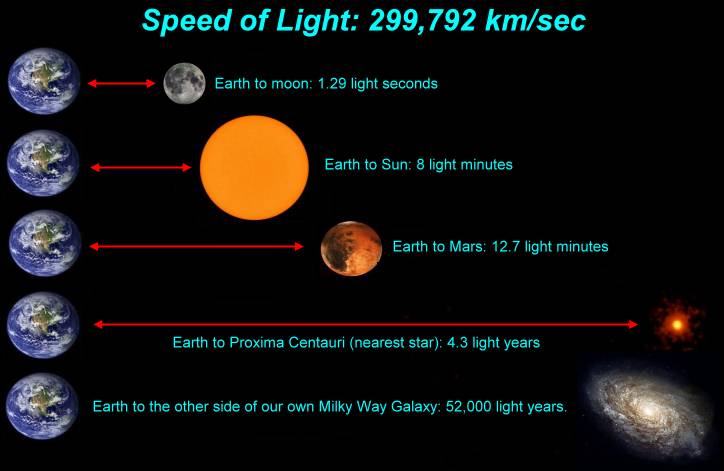 Light Years and Theories - Waxahachie Science Curriculum Ideas
Now, for a dash of practical advice: the next time you see Mars in the evening sky, bring a stopwatch. Right now, it’s about 12 light-minutes away. Wait one minute after you look, and that light started its journey one minute later than you thought. This simple act makes the distance tangible—a live time delay you can feel. If you’re into stargazing apps, use one that shows “light travel time” for planets. It’s a brilliant way to turn a number into an experience. For teachers or curious folks, set up a game: “Mars Call.” You ask a question, then count 25 seconds before expecting an answer (simulating a 12.5-minute round-trip). Watch how patience becomes a superpower—just like NASA’s rover drivers.
Finally, let’s tie it all together with a smile. The fact that Mars is only light-minutes away isn’t a letdown—it’s a celebration. It means we can see its polar ice caps, track its dust storms, and even park robotic explorers on its surface. If Mars were even one light-year away, all that would be impossible. So next time someone asks, “How far away is Mars in light-years?” you can grin and explain: “It’s zero—but it’s also the best 12-minute conversation you’ll ever have with a planet.” That intimate distance is what makes it humanity’s next great destination. Pack your bags… and maybe a few extra minutes for the data signal.
