How Did Imperial Dynasties Justify Their Power

Power Trips: A Historical Rollercoaster of Imperial Justifications Hey there, history buffs and casual curiosity-seekers! Today, we're diving into the fascinating world of im...

Power Trips: A Historical Rollercoaster of Imperial Justifications
Hey there, history buffs and casual curiosity-seekers! Today, we're diving into the fascinating world of imperial dynasties and how they justified their power. Buckle up, because we're about to take a wild ride through time, filled with fascinating stories and a whole lot of 'I can't believe they got away with that!' moments.
Divine Right: The Royal Seal of Approval
Let's kick things off with the Divine Right theory, a favorite among medieval European monarchs. These rulers claimed that their power came straight from the big man upstairs. They were, in essence, God's chosen ones, ruling by divine right. Talk about a resume booster!
Imagine being told, "Hey, you're in charge because the universe says so." Sounds like a pretty sweet deal, right? But it wasn't all sunshine and roses. Rulers had to keep up appearances, which often meant being super religious and pious. Talk about a high-pressure gig!
Must Read
Mandate of Heaven: When the Sky's the Limit
Now, let's hop over to ancient China and chat about the Mandate of Heaven. This was the Chinese equivalent of the Divine Right, but with a twist. Rulers here believed that their power came from the will of Heaven, but here's the kicker: if a ruler was cruel or unjust, Heaven would withdraw its mandate, and the ruler would lose their power.
It's like having a cosmic performance review. Talk about a motivator to keep your people happy! But, of course, it didn't always work out that way. Sometimes, rulers just didn't get the memo that they'd been fired from their celestial job.
Ancestor Worship: The Family Business
In many imperial dynasties, power was seen as a family affair. Rulers would claim that their power came from their ancestors, who were often deified after their deaths. Talk about some serious family pressure!
This was especially common in ancient Egypt, where pharaohs were seen as divine beings, with their power coming from their divine ancestors. It's like being the CEO of a multi-generational business, but with more gold and fewer board meetings.
Conquest and Legacy: The Power of Persuasion
Some rulers didn't need divine right or ancestral blessings to justify their power. They just took it. Conquest was a common way to gain power, and many rulers justified their rule by pointing to their military victories and the prosperity they brought to their new territories.
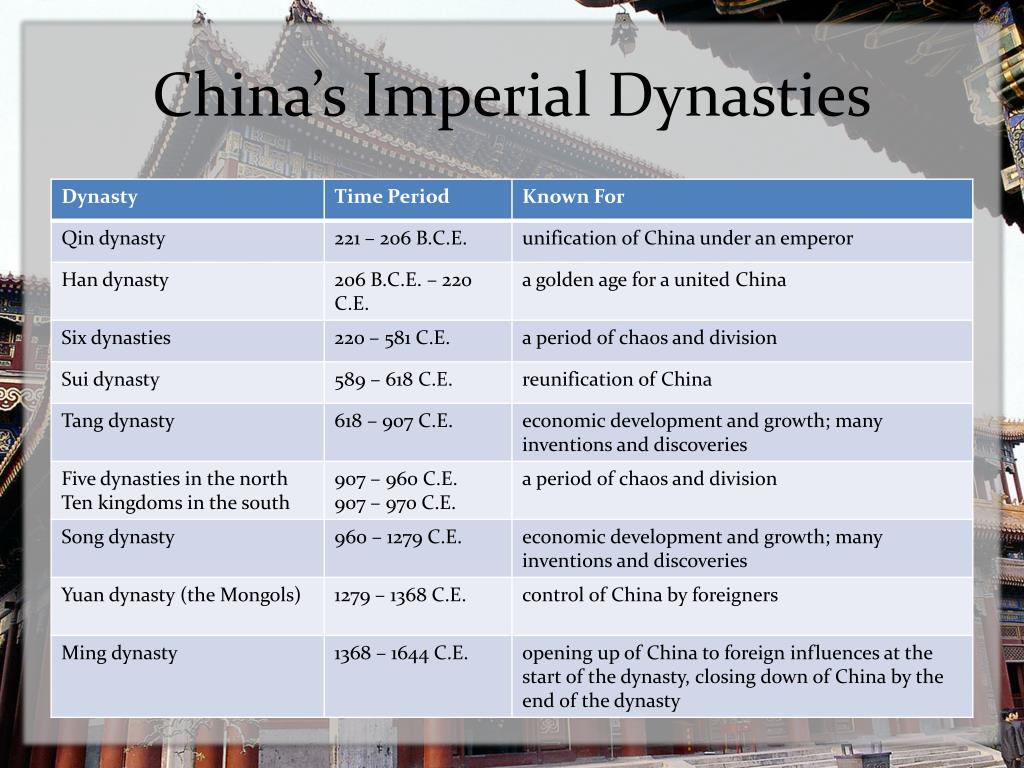 PPT - The Political Development of Imperial China PowerPoint
Think of it like a really, really intense job interview. "Sure, I might have invaded your country, but look at all the roads and aqueducts I've built!" It's not the most ethical approach, but it sure was effective.
So, Why Should You Care?
You might be thinking, "This is all well and good, but why should I care about how ancient rulers justified their power?" Well, let me tell you, friend, it's all about perspective. Understanding how these dynasties justified their power can help us understand the societies they ruled over and the people who lived in them.
Plus, it's just plain fascinating! It's like a real-life game of 'Would You Rather?' "Would you rather rule by divine right or by conquest?" It's not a question most of us will ever have to answer, but it's fun to think about!
So, the next time you're feeling a little power-hungry, remember the lessons of history. Maybe don't try to claim divine right or conquer your neighbors, but do try to be a good leader, whether that's at work, at home, or in your local community. After all, power isn't just about having it; it's about using it to make the world a better place.
And who knows? Maybe one day, you'll look back on your reign and say, "You know what? I ruled by the power of you." Because at the end of the day, that's the most powerful justification of all.
