Examples Of Insurable And Non Insurable Risk

Ever wonder why you can insure your phone against a cracked screen but not against you getting bored with it? That’s the quirky world of insurable vs. non-insurable risk. It’s...

Ever wonder why you can insure your phone against a cracked screen but not against you getting bored with it? That’s the quirky world of insurable vs. non-insurable risk. It’s a little like deciding what’s a good gamble and what’s just chaos. So, grab a coffee, and let’s dive into why some risks get a safety net while others are left to fend for themselves.
What’s the Big Deal? The Magic of Pure Risk
Insurance companies are super picky about what they’ll cover. They only love one type of risk: pure risk. That’s when there’s a chance of losing something, but zero chance of gaining something. Think: your house burning down or your car getting stolen. It’s sad, not speculative.
On the flip side, you’ve got speculative risk, which is the wild child. That’s when you could either win big or lose big. Like starting a business or betting on a horse. Insurers hate that because it’s unpredictable and—frankly—a little messy for their business models. They want steady, boring losses.
Must Read
So, the golden rule? Pure risks are usually insurable; speculative risks are usually not. But wait—there’s more nuance than a fine print on a contract!
Example #1: Your House Catches Fire (Yes, Insurable)
Picture this: lightning strikes your roof, and your living room goes up in smoke. That’s a classic insurable risk. Why? Because it’s a pure risk—you’re not gaining anything from the fire, just losing stuff.
Insurers can crunch the numbers on fire risk for thousands of homes. It’s like a math problem they love solving: they know roughly how many houses will burn each year. So, they pool everyone’s premiums and pay out to the unlucky few. Boom, financial safety net.
But here’s the cool part: they won’t cover it if you set the fire on purpose. That’s called moral hazard, and it’s a big no-no. Insurers are like, “Nice try, but we’re not funding your arson hobby.” They need the risk to be accidental.
Example #2: The Stock Market Crash (Not Insurable, Sorry)
Now imagine you invest your savings in a hot tech stock. It crashes, and you lose half your money. Can you get insured for that? Nope. This is speculative risk—you were hoping for a gain, and the loss came.
Why won’t insurers touch it? Because the stock market is systemic and tied to everyone’s emotions, governments, and weird tweets. It’s like trying to insure against a game of roulette where the wheel is controlled by a hyperactive octopus. Too chaotic, too unpredictable.
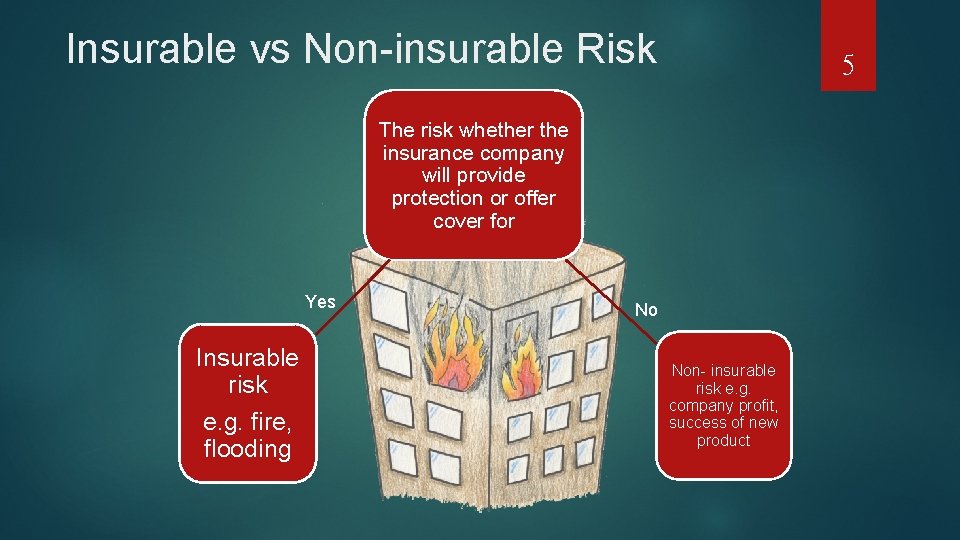 Lesson 2 The Insurable vs Non insurable Risks
Also, if insurance companies covered stock losses, everyone would just take crazy risks and expect a payout. The whole system would collapse. So, instead, you get diversification and financial advisors—which is basically your own “insurance” for bad bets.
Example #3: Your Dog Bites the Mailman (Insurable!)
This is one of my favorites. If your lovable but grumpy pooch nips the postal worker, you’re likely covered by your homeowner’s or renter’s insurance. Why? It’s a liability risk—a pure risk where you’re legally responsible for an accident.
Insurers can calculate how many dog bites happen per year per breed. They literally have actuarial tables for this. “Oh, a golden retriever? Low risk. A Rottweiler? We’ll charge a little more.” It’s morbid but fascinating, right?
The exception? If you leave your dog outside with a “FREE BITES” sign, that’s intentional damage. Insurers will laugh and say, “You wanted that liability. Good luck.”
Example #4: Your Kid Decides to Be a Skateboard Pro (Not Insurable)
Let’s say your child quits school to chase Olympic skateboarding glory. You can’t buy an insurance policy that pays you if they fail to become a pro. That’s a career risk, and it’s completely uninsurable.
Why? Because success depends on talent, hard work, luck, and a thousand unseen factors. Insurers can’t model “how many kids become skateboard legends” the way they model car accidents. It’s too idiosyncratic—unique to that kid and their world.
 Distinguish between insurable risk and non-insurable risk - Brainly.in
Plus, if you could insure failure, would you even try hard? The incentive to succeed would vanish. Insurance thrives on adversity, not ambition. So, you’re on your own for dreams—but hey, that’s part of the fun.
Example #5: Earthquake vs. “I Forgot My Umbrella” (Both Insurable, But…)
Earthquakes are insurable, but they’re a special case. They’re pure risk, but they’re also catastrophic—meaning they can hit everyone at once. Insurers often offer separate policies or use government backstops. It’s like a club that says, “We’ll cover you, but only if everyone chips in extra.”
Now, what about “I forgot my umbrella and got wet during a drizzle”? That’s a non-insurable risk—because it’s a minor inconvenience, not a financial loss. Insurers don’t care about your soggy hair. They care about significant monetary loss.
So, tiny risks like forgetting lunch or stubbing your toe? Those are just life’s punchlines. You’re the insurance company for yourself there.
Why This All Matters (and Why It’s Kind of Cool)
Understanding what’s insurable helps you stop wasting money on weird policies. You don’t need “alien abduction insurance” (though it exists—yes, really!), because that’s basically a speculative joke. But you do need health and home insurance because those are boring, predictable risks.
Also, it’s a neat lens to see the world. Insurance is basically society agreeing to share the bad luck buffet. It only works for risks that are random, measurable, and accidental. Everything else—like love, creativity, or starting a band—is up to you.
So next time you see an ad for “extended warranty on your fridge,” ask yourself: is this a pure risk, or am I just paranoid? The answer might save you a few bucks—or at least give you a fun story to tell at parties. Stay curious, and stay covered where it counts.
