20 Examples Of Multicellular Organisms

There’s something genuinely satisfying about looking at the world around us and realizing it’s built from teams, not solo players. Whether you’re a curious student trying to w...
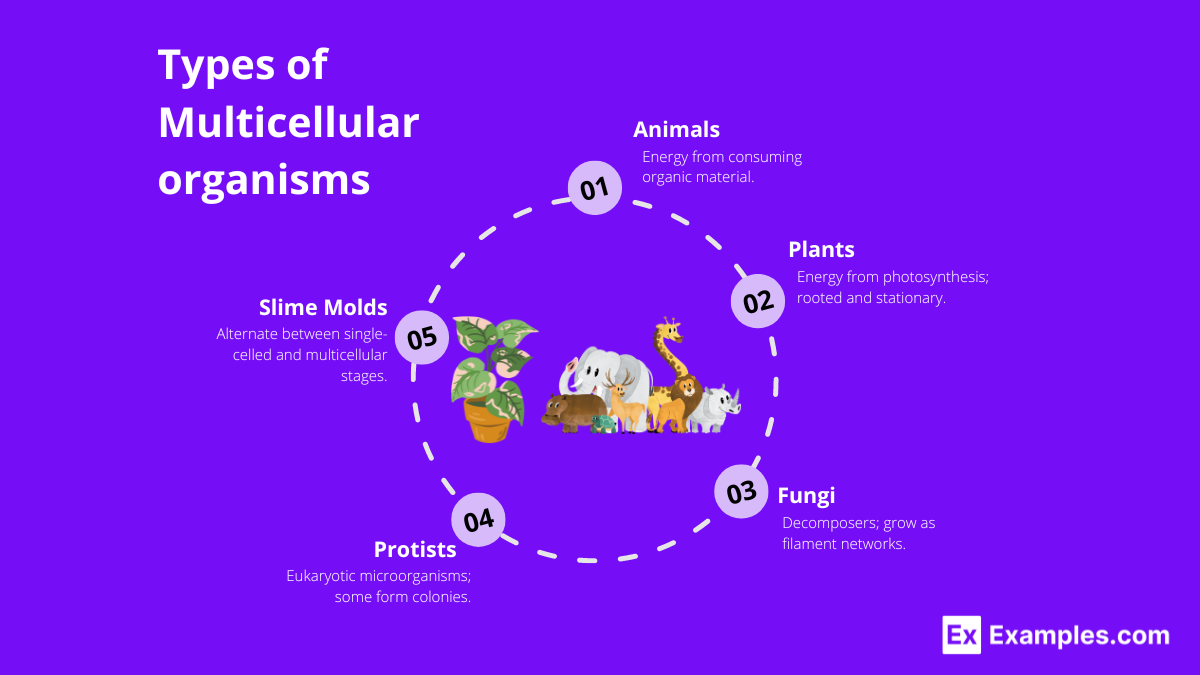
There’s something genuinely satisfying about looking at the world around us and realizing it’s built from teams, not solo players. Whether you’re a curious student trying to wrap your head around biology, a teacher looking for fresh examples, or just someone who enjoys noticing how life works, the topic of multicellular organisms is both practical and delightful. It’s like peeking behind the curtain of everyday life—everything from the frizz on a dandelion to the dog curled up on your couch is a community of cells working together. The main purpose here is simple: to show that being multicellular isn’t just about size, but about cooperation, specialization, and resilience. For gardeners, it helps explain why their roses bloom; for pet owners, why their cat purrs; and for anyone who’s ever marveled at a mushroom in the woods, it’s a reminder that life is wildly inventive.
Let’s start with the giants of the plant kingdom. Trees like oaks, pines, and maples are classic examples—each with roots, stems, leaves, and bark, all made of trillions of cells. The honey fungus in Oregon, one of the largest living organisms on Earth, is actually a multicellular network under the soil. Then there are the flowering plants: a single rose bush or a patch of daisies has specialized cells for photosynthesis, reproduction, and defense. Even the humble seaweed you see at the beach, like kelp, is a multicellular wonder, able to form entire underwater forests.
Now for the animal kingdom, where the variety is staggering. You probably recognize the big ones: humans, cats, dogs, and elephants are all multicellular. But don’t forget the smaller relatives: a fruit fly on your banana, a honeybee in your garden, or a blue whale in the ocean. Each is a highly coordinated system of cells, tissues, and organs. Even the common earthworm and the starfish you find tide-pooling are multicellular—they have muscles, nerves, and digestive systems, just scaled down.
Must Read
Fungi get less love, but they’re some of the most fascinating multicellular organisms around. The mushroom on your pizza (like a portobello or shiitake) is just the fruiting body; the real organism is a vast network of mycelium underground. Yeast is usually single-celled, but other fungi, like Penicillium mold on your old bread, form multicellular colonies. And for a truly weird example, consider the slime mold—it can exist as single cells, then merge into a multicellular slug-like creature when food runs low. Talk about teamwork!
 Multicellular Organisms Examples
Even the “simple” life forms hide complexity. Sponges are ancient multicellular animals that have specialized cells but no true tissues—they filter water through their bodies. Coral is a tiny multicellular animal that builds massive reefs. And let’s not forget the volvox, a green algae that forms a perfect hollow sphere of cells, each with a flagellum, working together to swim. These examples show that multicellularity isn’t a ladder—it’s a spectrum of cooperation.
If you want to make the most of this topic, start close to home. Go for a walk in your backyard or a local park and make a list of every living thing you see: the grass, an ant, a dandelion, a robin. Look at a cut apple—notice the core, seeds, and flesh, all made of different cells. For a hands-on tip, use a simple hand lens or your phone’s macro lens to examine a slice of mushroom cap or a leaf. You’ll spot the pattern of cells with your own eyes. Share your findings with a friend or keep a digital journal—suddenly, the world feels alive with tiny teams, and that’s a pretty wonderful thing to carry with you.
